
Camper Van Bathroom Setups That Actually Work
Wet bath vs dry bath, toilet options, waterproofing, and ventilation. How to fit a real bathroom into a van without wasting space or creating moisture problems.
Yes, you can fit a fully functional bathroom in most vans with a 144" wheelbase or longer, using a wet bath (24" x 30" to 30" x 36") with a composting toilet, shower, and FRP waterproof walls. Wet baths are the most space-efficient option, while dry baths with separate shower stalls need 30" x 48" or more and work best in 170" wheelbase vans. Emery Custom Builds waterproofs every van bathroom with FRP panels, marine-grade silicone, and waterproof membrane backup layers to prevent hidden moisture damage.
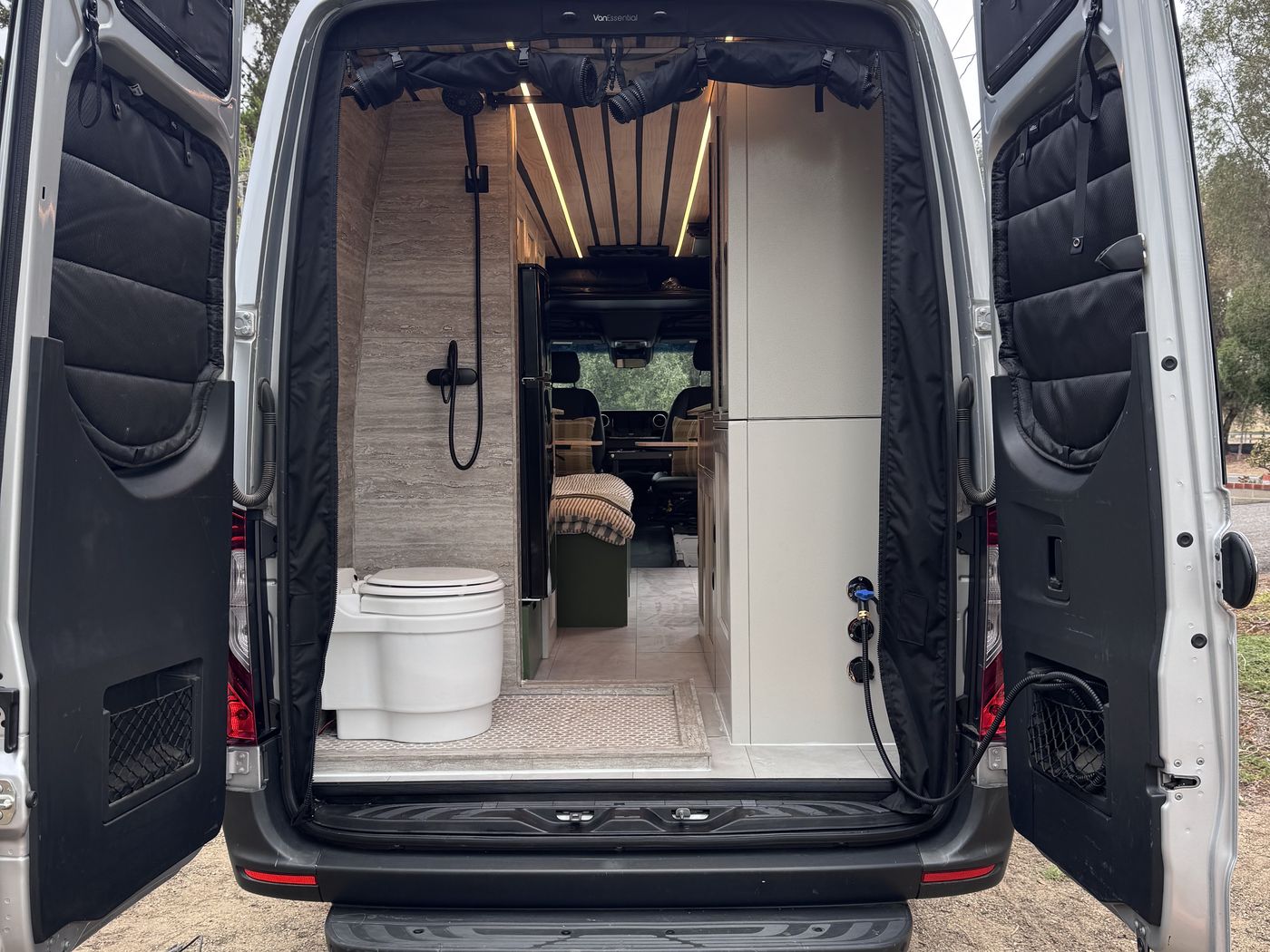
Grove's wet bath runs the full width of the rear of the van. Travertine tile on the walls, penny round mosaic on the floor, and a handheld shower on a slide bar. See the Grove build.
Why Does Having a Bathroom Change Van Life?
Having a bathroom in your van means you don't need to find a gas station at 2 AM, you don't skip showers for three days, and you don't plan your entire route around campground facilities. A well-designed van bathroom gives you real independence. The catch is that bathrooms take up valuable space and introduce water into a metal box that doesn't want to be wet. Getting the design, waterproofing, and ventilation right is critical.
We've built bathrooms in Sprinters, ProMasters, and Transits of different lengths. The options change based on how much space you have, but even a compact van can fit a functional bathroom if you plan it well.
What Is the Difference Between a Wet Bath and Dry Bath?
Wet Bath
A wet bath is a single waterproofed room where the shower, toilet, and sometimes a small sink all share the same space. When you shower, everything in the room gets wet. It's the most space-efficient bathroom option and the most common in van builds.
The entire enclosure — walls, ceiling, floor — is waterproof. You step in, shower, and the water drains through a floor drain connected to your grey water tank. After showering, a quick wipe-down and a few minutes with the vent fan running dries everything out. Most wet baths fit in a 24" x 30" to 30" x 36" footprint.
Dry Bath
A dry bath separates the shower from the toilet. The shower has its own enclosed, waterproofed area, and the toilet sits outside of it in a dry section. This is more comfortable and closer to what you're used to at home, but it takes more floor space — typically 30" x 48" or larger.
Dry baths work best in longer vans: 170" wheelbase Sprinters, extended-length Transits, or long ProMasters. In a 144" wheelbase van, a dry bath usually eats too much space to be practical unless you're willing to shrink your kitchen or sleeping area significantly.
What Type of Toilet Is Best for a Van?
Composting Toilets
Composting toilets are the go-to for most van builds. The Nature's Head and Cuddy are the most popular models. They work by separating liquid and solid waste — liquids go into a removable bottle, solids go into a chamber with a composting medium (coconut coir or peat moss). A small fan vents any smell outside through a hose.
When maintained properly, composting toilets are nearly odor-free. You empty the liquids every 2-3 days and the solids every 3-6 weeks depending on use. No black water tank needed, no dump stations required. They run on 12V power for the vent fan — about 0.1 amps, which is negligible on your electrical system.
Cassette Toilets
A cassette toilet has a removable waste tank (the "cassette") that you pull out and empty at a dump station or toilet. Thetford makes the most common models. They're simpler than composting toilets and cheaper upfront, but you need access to dump facilities more regularly — the cassette holds about 5 gallons and lasts 2-4 days for two people.
Cassette toilets use a small amount of water per flush and chemicals to control odor. They're a good option if you primarily camp at places with dump access and don't want to deal with composting maintenance.
What Are the Best Shower Pan Options for a Van?
The shower pan is the foundation of your van bathroom. It has to catch all the water, direct it to a drain, and prevent any moisture from reaching the van's metal floor.
- Prefabricated marine-grade pans: These are designed for boats and RVs. They're fiberglass or ABS plastic, come in standard sizes, and are the easiest to install. We trim and fit them to your van's floor contours.
- Custom-built pans: For non-standard sizes or specific layout needs, we build shower pans from scratch using a waterproof membrane over plywood substrate with fiberglass coating. More work, but you get the exact dimensions you need.
- Tileable pans: A custom pan built to accept tile on top. This gives you a residential-look shower floor but adds weight. We use this in premium builds where the aesthetic matters.
Every shower pan we install has a slight slope (1/4" per foot minimum) toward the drain. Standing water in a van bathroom is how you get mold, mildew, and eventually rot in your subfloor.
How Do You Waterproof a Van Bathroom?
Waterproofing is the most important part of a van bathroom. Water will find every gap, seam, and imperfection. We use multiple layers of protection:
- FRP (Fiberglass Reinforced Plastic) panels: These cover the bathroom walls and ceiling. FRP is the same material used in commercial kitchens and hospital bathrooms — it's waterproof, easy to clean, and won't degrade from constant moisture exposure.
- Marine-grade silicone: Every seam, joint, and penetration point gets sealed with marine-grade silicone. Standard bathroom caulk breaks down faster in a van because of vibration and temperature swings.
- Waterproof membrane: Under the shower pan and behind wall panels, we apply a waterproof membrane as a secondary barrier. If the primary seal ever fails, the membrane prevents water from reaching the van's structure.
We don't take shortcuts on waterproofing. A bathroom leak in a van can cause serious damage to insulation, electrical wiring, and the van's body that costs far more to repair than doing it right the first time.
How Do You Ventilate a Van Bathroom to Prevent Mold?
A van bathroom generates a lot of moisture — every shower puts humidity directly into your living space. Without proper ventilation, that moisture condenses on cold metal surfaces and creates mold and mildew problems fast.
We install a MaxxAir fan dedicated to the bathroom area or positioned nearby. Running the fan on exhaust during and after showers pulls moisture out through the roof. In many builds, the bathroom vent fan is separate from the main living area fan so you can ventilate the bathroom without cooling down the rest of the van.
Airflow under and behind wall panels also matters. We leave small air gaps behind FRP panels so trapped moisture can dry out rather than sitting against the van's metal walls. This detail is invisible once the build is done, but it's the difference between a bathroom that lasts and one that develops hidden mold.
What Are the Best Privacy Door Options for a Van Bathroom?
Your bathroom needs a door or enclosure that gives you privacy without eating up floor space when it's open. Here are the options we use:
- Accordion doors: The most popular choice for van bathrooms. They fold flat against the wall when open and extend across the opening when closed. They don't swing into the room like a hinged door, so they don't take any floor space.
- Sliding barn doors: A small barn door on a track slides across the bathroom opening. Looks great and works well if you have wall space next to the bathroom for it to slide into. Heavier than an accordion door but more solid feeling.
- Curtains: The simplest option. A heavy curtain on a curved rod works fine for a shower enclosure and costs nothing compared to a door. Not as private or sound-blocking, but practical and easy to wash.
- Pocket doors: A door that slides into the wall cavity. Clean look and takes zero floor space, but requires a thick enough wall to house the door — not always possible in a van where every inch matters.
How Much Space Does a Van Bathroom Need by Van Size?
Your van platform and wheelbase determine what kind of bathroom you can realistically fit.
144" wheelbase (standard length): You can fit a compact wet bath. Expect to dedicate about 12-15 square feet. The bathroom will be tight but fully functional. Most people stand in the shower and the toilet is right there. You'll trade some living space for it, but it's doable.
170" wheelbase (extended length): You have room for either a generous wet bath or a proper dry bath. The extra 26" of van length gives you enough space to separate the shower from the toilet without sacrificing your kitchen or bed. This is the sweet spot for a full bathroom build.
ProMaster width advantage: The ProMaster is about 6" wider than a Sprinter at the floor. That extra width can make a bathroom feel noticeably less cramped, especially for a wet bath where you're standing in a small space.
How Much Does a Van Bathroom Cost at Each Budget Level?
Bathroom scope and materials scale with your overall budget:
$30K-$50K builds: Compact wet bath with FRP walls, prefabricated shower pan, composting toilet, curtain or accordion door, shared vent fan with the main living space. Everything you need, kept simple.
$55K-$75K builds: Larger wet bath or small dry bath, upgraded shower fixtures, dedicated bathroom vent fan, better door hardware, possibly a small vanity or shelf for toiletries.
$80K-$120K+ builds: Full dry bath with tiled shower, premium fixtures, custom cabinetry around the toilet, solid privacy door, dedicated exhaust fan, and finish quality that looks like a residential bathroom built into a van.
Related guides: Systems Hub • Interior Systems • Plumbing • Ventilation • Our Build Process
Ready to Design Your Van Bathroom?
Tell us what matters most — shower, toilet, privacy, space — and we'll design a bathroom that fits your van and your priorities.
Tell Us About Your Build