
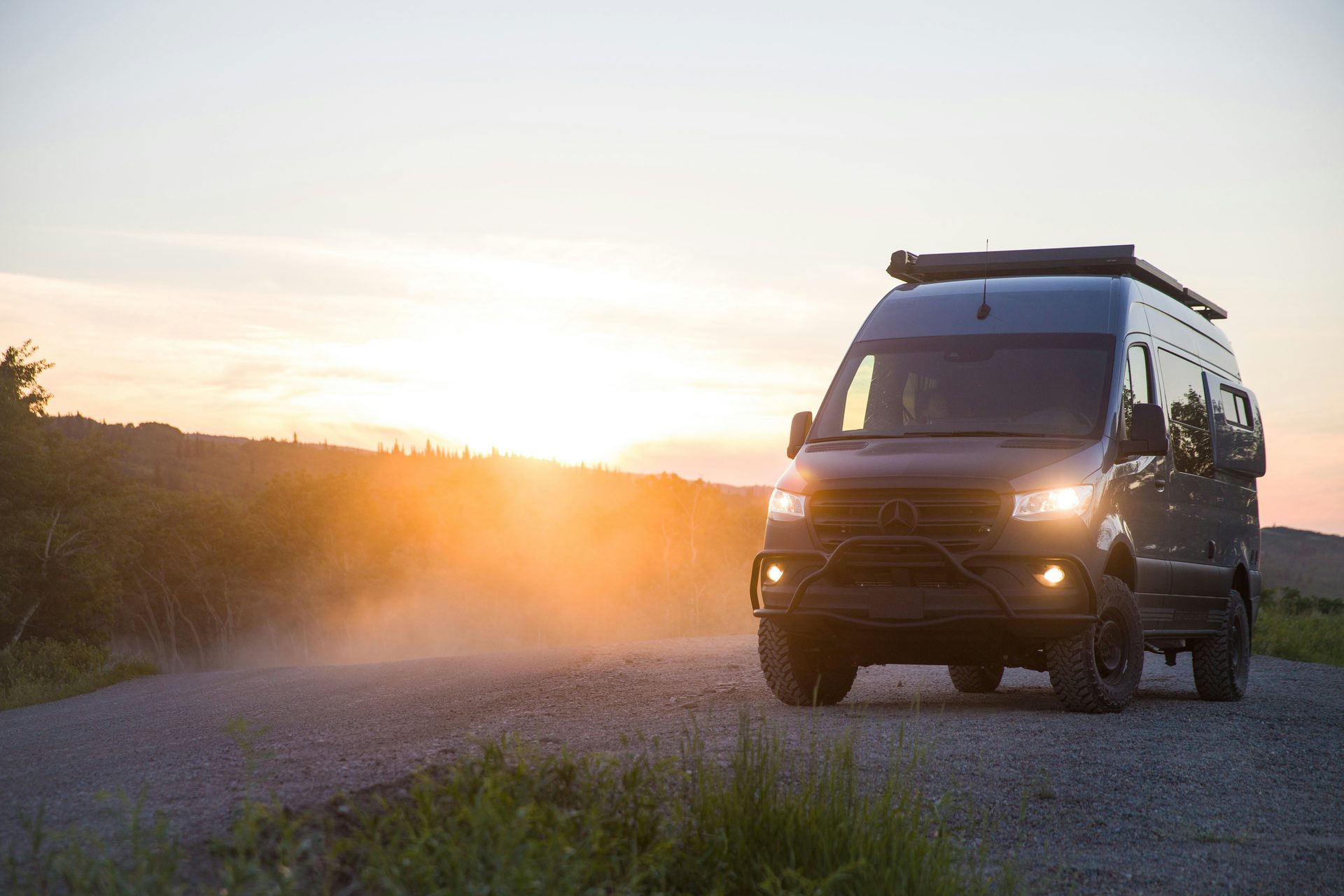
If you’re shopping for a 4x4 van to convert into a camper, you’ve probably already noticed that the options aren’t straightforward. Not every van platform offers four-wheel drive, the ones that do handle it differently, and the price premium can be significant. We build custom van conversions on Sprinters, Transits, and ProMasters, so we see the full range of what people bring in and what actually matters once you’re living in the van.
This guide breaks down everything you need to know about 4x4 and AWD vans: which platforms offer what, how much the upgrade costs, and whether you actually need it for the kind of travel you’re planning.
AWD vs 4WD: What’s the Actual Difference?
Before we get into specific vans, it helps to understand the two systems you’ll see discussed.
All-wheel drive (AWD) sends power to all four wheels automatically. There’s no lever to pull or button to press. The system detects when a wheel is slipping and shifts torque to the wheels with traction. It works well on wet roads, gravel, light snow, and mild trails. Most AWD systems are designed for on-road safety, not rock crawling.
Four-wheel drive (4WD) uses a transfer case that lets you manually engage all four wheels, usually with a low-range gear option. Low range multiplies torque at low speeds, which is what you need for steep inclines, deep sand, or technical terrain. Traditional 4WD is what you find on trucks and SUVs built for serious off-road use.
Here’s where vans get interesting: the Mercedes Sprinter 4x4 is technically an AWD system. On 2015-2022 models, it included a low-range button that engaged a mild 1.42:1 reduction ratio (for comparison, a real 4WD truck’s low range is typically 2.5:1 or higher). It also used open differentials with a 67/33 rear/front torque split. The 2023+ Sprinter AWD was redesigned with a 50/50 torque split and no low-range option at all. Neither generation is true 4WD, but both are more capable than a typical AWD crossover.
For van life purposes, most people use “4x4 van” and “AWD van” interchangeably. What matters more than terminology is ground clearance, tire selection, and whether the system has low-range gearing (and if so, how much reduction it actually provides).
4x4 Van Options by Platform
Mercedes Sprinter 4x4
The Sprinter is the only major van platform with a factory 4x4 option from the manufacturer. Mercedes has offered 4x4 on the Sprinter since 2015 in North America, and it’s the most popular choice for off-road van conversions by a wide margin.
How it works: The Sprinter 4x4 is an AWD system, not true 4WD. On 2015-2022 models, power goes to all four wheels with a 67/33 rear/front torque split through open differentials. These models have a low-range button on the dash, but the reduction ratio is a mild 1.42:1 (compared to 2.5:1+ on dedicated off-road vehicles). It helps on moderate grades and loose surfaces but isn’t comparable to a Jeep’s low range. The 2023+ models were redesigned with a 50/50 torque split and no low-range option at all, though the system is still full-time AWD and handles moderate terrain well. The body sits about 4.5 inches higher than the 2WD version, though actual ground clearance underneath is similar. The lift improves approach and departure angles.
What’s good about it:
- Factory-engineered, so the warranty covers it
- Low-range gearing on 2015-2022 models for moderate off-road situations (2023+ models lack low range but still perform well on unpaved terrain)
- Higher ride height and improved approach/departure angles out of the box
- Well-proven system with years of use in the van community
- Aftermarket lift kits and suspension upgrades are widely available
What’s not great:
- Adds $9,670 to the advertised starting price ($6,820 against the same High Output configuration — AWD requires the High Output diesel)
- Slightly worse fuel economy (1-2 mpg less)
- The 4x4 models are harder to find on dealer lots, especially in the longer 170” wheelbase
- Maintenance is more expensive due to the additional drivetrain components
The Sprinter AWD is the gold standard for 4x4 camper van builds. If you know you want off-road capability and you’re building a Sprinter, ordering the factory 4x4 is almost always the smartest path. Retrofitting a 2WD Sprinter to 4x4 after the fact is possible but more expensive and complex than buying it from the factory.
Sprinter 4x4 aftermarket upgrades: Many owners add a 2” lift kit, upgraded shocks (Agile Off Road and Van Compass are popular), and all-terrain tires (BFGoodrich KO2s are the go-to in 245/75R16). These upgrades run $2K-$5K on top of the factory 4x4 and meaningfully increase capability.
Ford Transit 4x4 (Quigley Conversion)
The Ford Transit does not come with a factory 4x4 option. Ford offers the Transit in rear-wheel drive only. However, the Transit has one of the best aftermarket 4x4 conversion options available through Quigley Motor Company.
Quigley has been converting Ford vehicles to 4x4 for decades. Their Transit conversion is a full 4x4 system with a two-speed transfer case, front differential, and front driveshaft. It’s not a bolt-on kit you do in your garage. It’s a professional conversion done at Quigley’s facility or through authorized dealers.
How it works: Quigley installs a new transfer case behind the factory transmission, adds a front driveshaft and front differential, and modifies the front suspension geometry. The result is a true 4x4 system with low-range capability.
What’s good about it:
- True 4x4 with low range, not just AWD
- Ford’s Transit platform is already durable and well-supported
- Can be ordered through Ford dealers as a Quigley upfit before delivery
- Some Ford fleet financing programs cover the conversion cost
What’s not great:
- Costs $15,145-$16,145 for the conversion on pre-2020 Transits, by engine
- Adds weight and complexity to the drivetrain
- Fewer shops are familiar with servicing the Quigley system compared to factory Sprinter 4x4
- Lead times can be long depending on Quigley’s backlog
If you’re planning a Transit van conversion and want 4x4, the Quigley route is your primary option. The conversion is well-regarded in the van community, and the Transit’s lower starting price compared to the Sprinter can offset some of that conversion cost.
Planning ahead matters with Transit 4x4. If you’re buying a Transit specifically for a van conversion, talk to us early. We can help you coordinate the Quigley conversion timing so it fits into the overall build timeline without adding unnecessary delays.
RAM ProMaster: No 4x4 Option
The RAM ProMaster is front-wheel drive, and there is no factory 4x4 or AWD option. Aftermarket 4x4 conversions for the ProMaster do exist through specialty shops like OZK Customs, but they are rare, expensive, and significantly more complex than converting a RWD van.
This is the ProMaster’s biggest limitation for off-road-focused van lifers. The front-wheel-drive layout actually handles surprisingly well in light off-road conditions. FWD pulls the vehicle rather than pushing it, which gives decent traction in mud and loose gravel. But it’s not 4x4, and it won’t handle the same terrain that a Sprinter 4x4 or Quigley Transit can manage.
If you’re considering a ProMaster van conversion and occasionally want to get off pavement, good all-terrain tires and careful route planning go a long way. The ProMaster’s lower ride height is actually an advantage for daily use and loading, and most van lifers don’t need 4x4 as often as they think.
For a side-by-side look at how these platforms compare beyond just drivetrain, check out our Sprinter vs ProMaster comparison.
How Much Does a 4x4 Van Actually Cost?
The 4x4 premium varies depending on which route you take. Here’s what to expect in 2026:
| Route | Additional Cost | Notes |
|---|---|---|
| Sprinter factory AWD | $9,670 | Added when ordering; requires the High Output diesel |
| Sprinter aftermarket 4x4 retrofit | $15K-$20K+ | More expensive than factory, voids some warranty |
| Transit Quigley 4x4 | $15,145-$16,145 | Pre-2020 Transits only; professional conversion, parts and labor |
| ProMaster | N/A | No factory option; rare aftermarket conversions exist but are expensive |
These are just the drivetrain costs. Most people who go 4x4 also invest in suspension upgrades, better tires, and sometimes a lift kit. Budget an additional $4K to $8K for those supporting modifications on a heavy conversion, depending on how far you go: shocks, springs and correct Load Range E tires sit near the bottom of that range, while a full 2 inch lift with an alignment and new wheels sits near the top. Our van suspension upgrade guide breaks down every tier with current prices.
When you factor in the total cost of a van conversion, the 4x4 premium is a meaningful chunk. On a mid-range build running $35K-$55K for the conversion itself (labor and materials, vehicle not included), adding $7K-$15K for 4x4 represents a 15-30% increase in your total project budget.
That said, if off-road access is central to how you plan to use the van, it’s money well spent. Retrofitting 4x4 later is either impractical (ProMaster aftermarket conversions exist but are rare and costly) or significantly more expensive than doing it upfront.
Thinking About a 4x4 Van Build?
Whether you’re starting with a Sprinter 4x4 or considering the Quigley conversion for a Transit, the drivetrain decision affects the rest of the build. Suspension, undercarriage protection, and even layout choices shift when you’re building for off-road use. We help clients work through these decisions during the planning phase. Tell us about your build and we’ll get back to you with a custom estimate.
When You Actually Need 4x4 (and When You Don’t)
This is where we’re going to be honest, because the van community sometimes oversells 4x4.
You probably need 4x4 if:
- You chase ski resorts in winter. Mountain roads with packed snow and ice are where 4x4 earns its keep. AWD with good tires works too, but low-range gearing helps on steep, icy grades.
- You camp on BLM land regularly. Bureau of Land Management land often means unpaved access roads that can be sandy, rutted, or washed out. 4x4 lets you reach the good spots.
- You travel to remote backcountry. National forest roads, desert washes, mountain passes with loose rock. If your travel style involves getting away from established campgrounds, 4x4 opens up terrain that 2WD can’t safely handle.
- You plan to travel internationally. Overlanding in Central America, South America, or Africa often means unpaved roads as the default, not the exception.
You probably don’t need 4x4 if:
- You mostly stay at campgrounds and RV parks. These are paved or well-maintained gravel. 2WD is fine.
- You travel the West Coast corridor. Highway 1, the 101, and most national park campgrounds are fully paved.
- Your “off-road” is maintained forest service roads. Most forest service roads are graded gravel. A 2WD van with decent tires and reasonable ground clearance handles these without issue.
- You’re weekend warriors. If you’re out 2-4 weekends a month and mostly sticking to known spots, 4x4 is insurance you’ll rarely use.
The honest math: about 80% of van lifers would be perfectly fine with 2WD and a set of quality all-terrain tires. The other 20% who actually need 4x4 know exactly who they are, because they’ve already gotten stuck or turned around on a road they wanted to take.
4x4 Van Pros and Cons Summary
Pros
- Access to more terrain. This is the obvious one. Snow, sand, mud, loose gravel, steep grades. 4x4 opens up places you can’t reach otherwise.
- Confidence in bad conditions. Even if you don’t use low range often, knowing you have it changes how you plan trips. You don’t have to check weather reports as obsessively or avoid certain routes.
- Higher resale value. 4x4 Sprinters hold their value extremely well. A 4x4 Sprinter camper van sells faster and for more money than an equivalent 2WD build.
- Better traction in everyday driving. Rain, gravel shoulders, muddy campground entrances. AWD/4x4 handles all of it better than 2WD.
Cons
- Higher upfront cost. $7K-$15K+ depending on platform and route. That money could go toward a better electrical system, nicer interior, or a longer build timeline with more custom work.
- Lower fuel economy. Expect 1-3 mpg less than the 2WD equivalent. Over 100,000 miles at current diesel prices, that adds up.
- More maintenance. Additional drivetrain components mean more fluid changes, more potential failure points, and higher repair bills. Transfer cases, front differentials, and CV joints all need attention.
- Added weight. The 4x4 system adds 200-400 lbs to the vehicle. That matters when you’re building out the interior and trying to stay under the van’s gross vehicle weight rating.
- Harder to find. 4x4 Sprinters are in high demand and often have dealer markups. Quigley Transit conversions add lead time. If you’re on a tight timeline, the 4x4 search can delay your project.
Tips for Buying a 4x4 Van
If you’ve decided 4x4 is right for your build, here are some practical buying tips:
For Sprinter 4x4 buyers:
- Order new if you can. Used 4x4 Sprinters command a premium, and you’ll have less control over options and condition. Factory ordering takes 3-6 months but gets you exactly what you want.
- Prioritize the 170” wheelbase for full builds. The 144” works for weekend vans, but if you want a bathroom, full kitchen, and fixed bed, the 170” is the way to go.
- Budget for suspension upgrades. The factory suspension is adequate but not great for heavy builds. Plan on upgrading to something like the Agile Off Road or Van Compass kit. Note that shocks and springs, not a lift, are what fix how a loaded van drives, and that only tires raise the rear differential.
For Transit Quigley buyers:
- Coordinate with your builder early. The Quigley conversion needs to happen before the interior build. Talk to us during the planning phase so we can sequence everything correctly.
- Get the extended length if possible. The Transit 148” extended high roof gives you the best interior volume for a full conversion.
- Factor in total cost honestly. A Transit with Quigley 4x4 can approach Sprinter 4x4 pricing when you add everything up. Run the real numbers before committing.
For anyone considering 4x4:
- Test drive in 2WD first. If you haven’t spent time driving a full-size van, do that before adding 4x4 complexity. Get comfortable with the size and handling.
- Talk to people who have it. Van life forums and communities are full of 4x4 owners. Ask them how often they actually use it. The answers might surprise you.
- Don’t let FOMO drive the decision. Instagram makes every van look like it’s parked on a mountain peak. Reality is most of those photos were taken 50 feet off a paved road.
The Bottom Line on Four-Wheel Drive Vans
A 4x4 van is a real asset if your travel style demands it. The Sprinter factory 4x4 is the most straightforward option, the Quigley Transit conversion is a solid alternative, and the ProMaster simply isn’t in this conversation. The cost premium is real but justifiable for the right owner.
If you’re not sure whether you need 4x4, think about your last 10 camping trips. How many times did you wish you had more traction? If the answer is rarely, save the money and put it toward the build itself. If you were turning around or getting stuck regularly, 4x4 is worth every dollar.
We build 4x4 van conversions and 2WD builds alike. The drivetrain doesn’t change our process or quality. It just changes where you can park when the build is done.
Ready to talk about your build? Tell us about your build and we’ll get back to you with a custom estimate. We’ll help you figure out the right platform, the right drivetrain, and the right build scope for how you actually plan to use the van.