
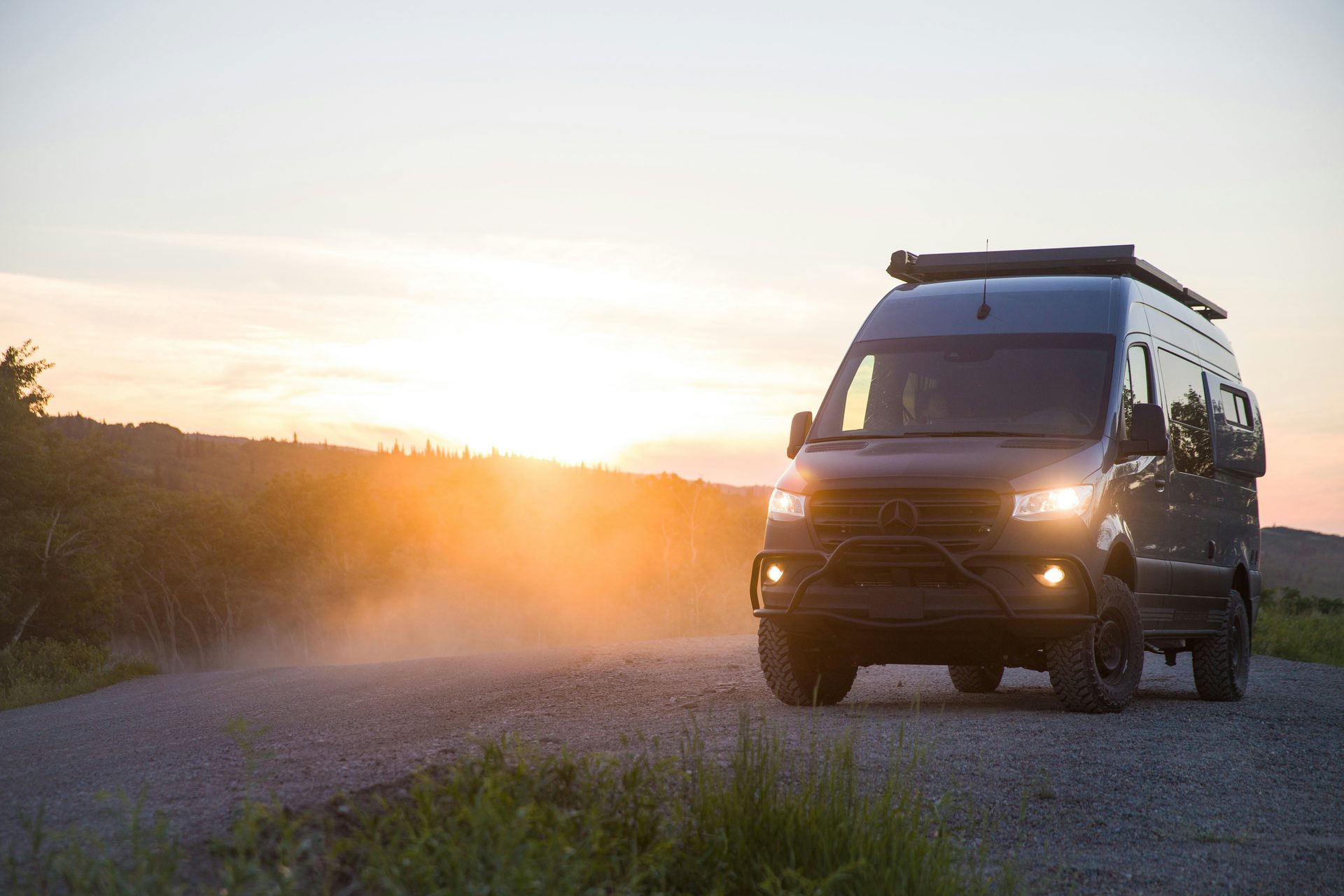
Most people asking about van suspension are really asking one question: how do I stop dragging the bottom of my van on forest roads. The answer that gets sold is a lift kit. The answer that works is usually something else.
We build custom conversions in Encinitas, and a finished van leaves our shop somewhere between 8,000 and 9,000 pounds. That weight changes what the suspension needs to do, and it changes which upgrades are worth paying for. This guide covers the whole range, from a $270 helper spring to a $5,700 lift system, with real prices and an honest account of what each one delivers.
A note on the numbers: every price here was checked in August 2026, and most of these parts are sold by several retailers at genuinely different prices. We have seen the same sway bar listed at $528 and at $762 on the same day. Treat the figures below as the shape of the decision rather than a quote, and check the current price before you buy.
Start Here: A Lift Does Not Raise Your Differential
This is the part that gets skipped, and it changes the whole decision.
The rear differential on a Sprinter is bolted to a live axle. That axle is located by the tires, sitting at whatever height the tires put it. When you install a 2 inch lift, you are raising the body, the frame, the steps and the running boards away from the axle. The axle itself does not move. Neither does the differential hanging off it.
On a dirt road or in deep snow, the part that makes contact is almost always the rear differential. Van Compass, who sell some of the best lift kits on the market, say this on their own website: larger tires are the only way to gain ground clearance under the live rear axle on a Sprinter van. They also note that in their experience the rear differential is the most common part of the undercarriage to hit the ground off-road.
So the arithmetic is simple. A tire adds half of its diameter increase at the axle:
| Tire size | Diameter | Clearance gained at the axle |
|---|---|---|
| 245/75R16 (factory) | 30.5” | baseline |
| 265/70R17 or 265/75R16 | 31.6” | +0.55” |
| 275/70R17 | 32.2” | +0.85” |
| 285/75R16 | 32.8” | +1.15” |
| 35x12.50R17 | 35.0” | +2.25” |
A 2 inch lift, by comparison, adds exactly zero.
That does not make lifts useless. A lift creates the wheel well room those bigger tires need, restores suspension travel that conversion weight has eaten, and helps on side hits and approach angles. It is a real product that does a real job. It is just not the thing that lifts your differential over a rock, and it should not be sold that way.
What Actually Fails on a Loaded Van
Before spending anything, it helps to know what people actually complain about once their van is finished and heavy. In order of how often we hear it:
Rear sag. Nearly universal. A conversion puts several hundred pounds behind the rear axle, and the factory leaf pack was not designed around it. One owner measured his rear end sitting 1.75 inches lower than stock.
Crosswind and passing instability. The most emotionally reported problem, and the one people describe as unsafe. A tall van gets shoved around by wind and by trucks. Every owner we found who fixed it did so with shocks, not with a lift.
Low speed side to side rocking. The wallowing feeling on uneven ground. Van Compass’s own designer describes the stock setup as close to violent in this respect.
Harsh bottom-out. The bang when the suspension runs out of travel. The cheapest problem on this list to fix.
Worn factory shocks. They tend to be finished somewhere around 50,000 to 60,000 miles. On a used van bought for conversion, this is sometimes the entire problem, and people spend thousands chasing it with the wrong parts.
Every item on that list is a spring or damper problem. None of them is solved by lifting the van.
The Full Range, With Real Prices
Tier 1: Load assist
These support weight. They do not damp anything, they do not lift the van, and none of them raises your gross vehicle weight rating. Air Lift describes their own product as load levelling, not load increasing. If you are over your weight rating, the answer is less gear or a different chassis, not an air bag.
| Product | Price | Install |
|---|---|---|
| Timbren SES rear | $317 | 30 to 60 minutes, no drilling, no alignment |
| SumoSprings rear | $295 to $664 | About an hour per axle |
| SuperSprings helper leaf | $537 to $590 | Bolts over the factory pack |
| Air Lift LoadLifter 5000 | $850 | 2 to 4 hours with line routing |
Worth knowing: SumoSprings Rebel bump stops are not compatible with Van Compass Falcon shocks. The bracket contacts the shock body. Do not stack them.
Tier 2: Shocks
This is where most of the driving complaints get solved.
| Product | Price | Labor | Alignment |
|---|---|---|---|
| Fox 2.0 rear shocks, pair | $350 | 1 hour | No |
| Bilstein B6 front struts, pair | $432 | 2 to 3 hours | Yes |
| Van Compass Stage 1 | $1,727 | 5 hours | No |
| Van Compass Stage 2.3, adjustable | $2,939 | 5 hours | No |
One piece of Sprinter trivia that matters here: the stock front strut carries no spring. Ride height comes from a transverse leaf spring that is not attached to the strut at all. That has two practical consequences. The first is that you cannot level a Sprinter the way you level a pickup, by dropping a spacer on top of a front coil, because there is no front coil to sit on. Front spacers do exist on this platform, but only as part of a full lift kit that also drops the subframe, and Agile sell a front coil assist that adds a coil spring alongside the factory transverse leaf. The second is that Van Compass front shock kits are auxiliary shocks bolting alongside the factory strut rather than replacing it, so installing them requires no alignment.
It also means that if somebody offers you Bilstein 5100s for a Sprinter, they are guessing. That line does not exist for this platform. B6 is the real answer.
Tier 3: Sway bar
| Product | Price | Install |
|---|---|---|
| Hellwig rear sway bar | $528 to $762 | 1.5 to 3 hours, no alignment |
| Genuine Mercedes rear bar kit | $618 | Similar |
For a tall 170 inch van this is the best value per dollar in the entire guide, and the price spread between retailers is wide enough to be worth ten minutes of shopping. Before buying one, look underneath: a lot of Sprinter 2500s were ordered by dealers with the rear sway bar deleted. That is a five minute check that can change your whole plan and costs nothing. The Hellwig bar fits vans with or without a factory bar, but single rear wheel models only.
There is no aftermarket front sway bar for the Sprinter. The factory bar is semi-integrated into the front end.
Tier 4: Levelling and small lift
| Product | Price | Result | Labor |
|---|---|---|---|
| Rear mini leaf spring pack | $706 | 1 to 1.5 inches of rear lift | 3 hours |
| Front coil assist kit | $600 | 1 to 1.5 inches of front lift | Shop, needs spacers |
| Van Compass Stage 3 | $2,433 | Shocks, bump stops and rear pack | 7 hours |
| Van Compass Stage 4.3 | $3,645 | Same with adjustable shocks | 7 hours |
The rear mini pack only works with a factory two leaf rear spring. Count the leaves before ordering.
Tier 5: True 2 inch lift
| Product | Price | Labor |
|---|---|---|
| Striker 2 inch lift kit | $2,823 | 12 hours plus alignment |
| Standard ride improvement package | $2,984 | Shop quote |
| Van Compass Stage 6.3 | $5,762 | 17 hours plus alignment |
A proper lift kit is more involved than most people expect. A complete one includes front strut spacers, front subframe drop spacers, engine and transmission mount spacers, a steering shaft extension, a power steering hose extension, brake line relocation brackets, a replacement leaf pack, extended sway bar links, shock relocation brackets, bump stop drop brackets and a headlight levelling sensor bracket. On the 2023 and newer AWD it also includes cams to re-clock the front differential.
Two things are not in the box and are commonly forgotten. An alignment is required, typically $200 to $300. And you may need camber shims once the van settles, which is a reason to drive it a few hundred miles before paying for the final alignment.
Tires: Load Range E Is Not Optional
The rear axle rating on a Sprinter 2500 is 5,357 pounds. That means each rear tire has to carry 2,679 pounds.
| Size | Load Range C, pair | Load Range D, pair | Load Range E, pair |
|---|---|---|---|
| LT245/75R16 | 4,410 lb | 5,250 lb | 6,090 lb |
| LT265/70R17 | 4,940 lb | 5,820 lb | 6,390 lb |
| LT275/70R17 | 5,200 lb | 6,170 lb | 6,390 lb |
Load Range C fails in every size. Load Range D fails on the factory size by about 107 pounds. There is also a second reason that has nothing to do with the load chart: a Load Range C tire maxes out at 50 psi, and Mercedes specifies 70 psi at the rear on a fully laden van. The tire physically cannot get there.
This matters more than it should, because several of the most commonly recommended Sprinter tires are also sold in Load Range C in exactly the size people are told to buy. We have seen 265/70R17 listed in Load Range C in both the BFGoodrich and Toyo all-terrain lines, sometimes on the same retailer page as the Load Range E version of the same tire and at a similar price. The same size is sold as a passenger rated tire too, carrying only around 2,400 pounds. None of this means those are bad tires. It means the size alone does not tell you what you are buying, and the cheaper listing is often the one that will not carry your van.
When you buy, the markings to look for are LT and E. Match the manufacturer’s product code, not just the size.
People worry that Load Range E rides harshly. That complaint comes from light trucks running E rated tires empty. An 8,000 to 9,000 pound van is precisely the load these tires were designed for. Manage ride quality with pressure instead: something like 57 psi front and 77 psi rear on a full build, 50 and 70 on a lighter one.
What fits
At stock height, a 265/70R17 or 265/75R16 is the upsize most people land on, and it usually needs only a mudflap relocation kit, around $90. Fitment still depends on your wheel offset and drive type, so confirm against a current fitment guide rather than assuming. A 275/70R17 is the practical ceiling and may need fender trimming, though bolt-on no-rub fenders exist for about $190 if you would rather not cut anything.
Two limits worth knowing before you go bigger. The factory underslung spare carrier tops out around 31.5 inches, so a 275/70R17 needs an inexpensive bracket kit and some persuasion, and anything larger needs fabrication or a rear door carrier. And adaptive cruise control starts throwing faults past roughly an 8 percent diameter change. Distronic and Active Brake Assist go down together with a dash message, and the fault can take a thousand miles or more to appear.
What bigger tires cost you
Expect about 1 to 1.5 mpg, and most of that is tread pattern rather than diameter. One owner switched to a taller tire and gained fuel economy by moving from an aggressive all-terrain to a quieter one.
Your odometer will under-count, which means service intervals arrive early. The speedometer needle over-reads about 3 percent from the factory, so at 265/70R17 the two errors roughly cancel and the needle becomes honest while the odometer does not. Correction modules exist, around $700, but confirm the model year is supported before buying.
Braking deserves a mention we cannot quantify. No one has published measured stopping distances for a Sprinter on oversized tires. What we can say is that the rotor does not get bigger when the tire does, and the tire itself gets heavier. Both brake upgrade vendors serving this platform describe the factory system as marginal on a 9,000 pound van.
What We Recommend
For a heavy Sprinter AWD used for ski trips, surf trips and forest service roads, but not for rock crawling, the package that delivers the most for the money is shocks and springs plus correct tires. Not a lift.
That means a Stage 3 style package at around $2,433 in parts and 7 hours of labor, plus a set of Load Range E tires in 265/70R17. It fixes all five of the problems listed at the top of this page, levels the van about 1.25 inches at the rear so it stops looking squatted, and delivers more real clearance under the differential than a 2 inch lift would. It requires no alignment, no subframe drop and no changes to the driveline.
The upgrade path is the argument that usually settles it. Van Compass sells the lift as an explicit upgrade kit for people who already own a Stage 3 or 4.3, at around $2,117. Nothing you buy now gets thrown away if you decide later that you want the height and the bigger tires.
If you want visible lift immediately in a single purchase, a bolt-on ride improvement package at around $2,984 gets you roughly 1.5 to 2 inches front and rear with replacement leaf springs sized to your measured axle weight, and no subframe work.
What we would steer you away from is the top tier system at $5,762 plus 17 hours, unless you genuinely intend to run 33 inch tires and drive terrain that justifies it. On a van that mostly sees pavement, dirt roads and snow, that money buys adjustability you will not use.
Two Things To Check Before You Spend Anything
Weigh the van, loaded, one axle at a time. Every serious spring vendor sizes their product by actual rear axle weight, and one of them says so in writing. A CAT scale costs about $15 and removes all the guesswork. Also read the sticker in the driver’s door jamb: some earlier vans carry a gross weight rating of 8,550 pounds, which means a finished 9,000 pound conversion is over its rating before you touch the suspension. No tire or spring fixes that.
On a 2023 or newer AWD, have the front driveshaft inspected. Two suspension companies have publicly documented front driveshaft separation on these vans, including on stock, un-lifted, low mileage examples, and owners have reported the same thing on the Sprinter forums. To be clear about what that is and is not: this is aftermarket and owner reporting, not a Mercedes service bulletin or a recall, and we have not found one. One owner found the shaft nearly disconnected at 2,600 miles on a van that had never left pavement. Two separate suspension companies independently sell the same $80 to $100 spacer to address it, which tells you something. It takes minutes to look at and it is the cheapest peace of mind on this page.
The Short Version
Buy shocks and springs to fix how your van drives. Buy tires to gain ground clearance. Buy a lift when you want the tires that need the room, and know that is what you are buying.
If you are planning a build and want the suspension specified around the weight your van will actually finish at rather than a guess, that is a conversation worth having before the cabinets go in.