
Solid-State Lithium Batteries: Are They Worth It for Vans?
Solid-state batteries are showing up in van power gear reviews. Here's what the tech means for your build and why we still spec proven LiFePO4 banks.
If you follow overland and van life gear coverage, you have probably seen solid-state lithium batteries mentioned as the next step up from standard lithium. A few manufacturers are starting to ship early solid-state products into the outdoor power market, and the reviews are generating buzz. Customers have started asking us about it before we even get to the electrical section of a build conversation.
Here is what is actually going on, and why we still spec standard LiFePO4 in every van we build today.
What “solid-state” actually means
Every lithium battery moves charge between a positive and negative electrode. In a standard lithium battery, including the LiFePO4 chemistry we use, that charge travels through a liquid electrolyte. A solid-state battery replaces that liquid with a solid material instead.
That single change is where the reported benefits come from. Industry coverage points to a few consistent advantages: higher energy density, meaning more usable capacity in the same size and weight of battery, improved thermal stability, and a longer expected cycle life. Removing the liquid electrolyte also removes a failure point that liquid-based batteries have to manage.
None of that is invented marketing. It is the real physical argument for the technology, and it is why solid-state is getting attention in electric vehicles, consumer electronics, and now portable power.
Why it would matter for a van build specifically
Space and weight are always tight in a conversion. Every pound and every cubic inch you spend on the battery bank is a pound and a cubic inch you do not have for water, gear, or living space. A battery technology that packs more usable capacity into a smaller, lighter box is a genuine win for a van, more so than for a house battery wall where space is not a constraint.
Where solid-state actually stands right now
This is the part that matters if you are planning a build this year. The solid-state products hitting the market right now are mostly smaller, portable units aimed at camping and emergency backup power, not the 200Ah to 600Ah house banks a full van electrical system needs. Pricing for solid-state cells is still well above standard lithium, and the manufacturing base for larger-format solid-state batteries is nowhere near as mature as it is for LiFePO4.
That gap will close eventually. It is not likely to close on a timeline that should change what you spec for a build going out this year or next.
What we install today, and why
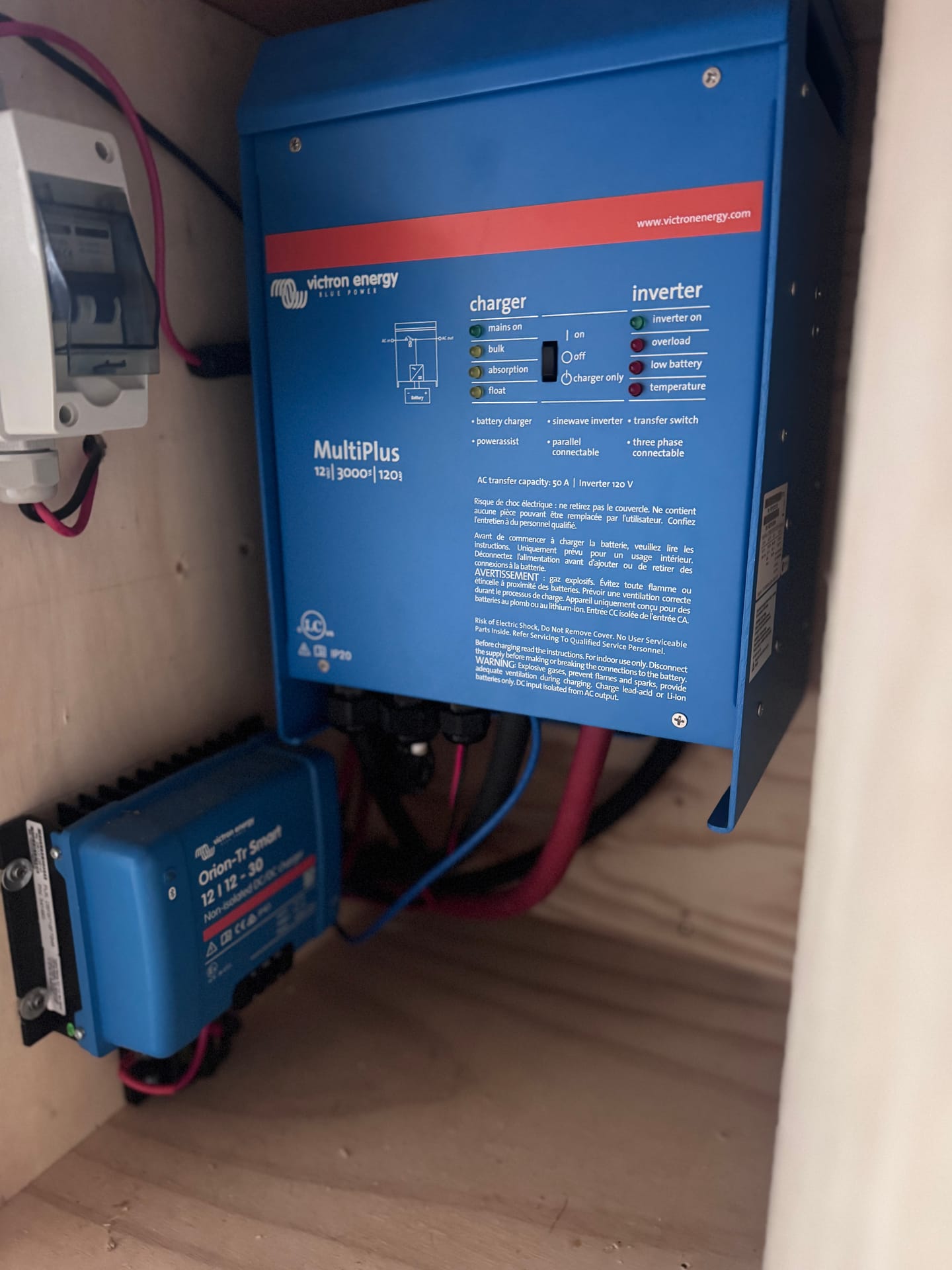
We build every electrical system around a Victron 3000W inverter/charger, Victron MPPT solar charging, and Victron Orion DC-DC alternator charging, paired with a Renogy lithium bank sized to how you actually use the van. That means we look at trip length, what you run day to day, and how much driving and sun you typically get, then size the bank to match instead of defaulting to a fixed number. Most builds land somewhere between 200Ah and 600Ah.
That combination has years of field use behind it, a real parts and service network if something ever needs attention, and a price point that fits inside a realistic build budget. You can read more about why we build around Victron on our electrical system page, and see how battery capacity fits into overall project cost on our van build budget guide.
Should you wait for solid-state?
If you are building a van in the next year or two, no. The technology is real and worth watching, but it is not available yet at the capacity, price, or track record a full build needs. Standard lithium, done right, sized to your actual usage and backed by a proper charging system, is still the correct call for a van you are going to live in and depend on.
We will keep watching solid-state as it matures, and we will spec it the day it makes sense for a real build instead of a camping accessory. Until then, we would rather put you in a system with years of proof behind it than a battery that is still finding its footing.
If you want to talk through what a power system should actually look like for how you use your van, get in touch. We will walk through your real usage before we spec a single watt.