
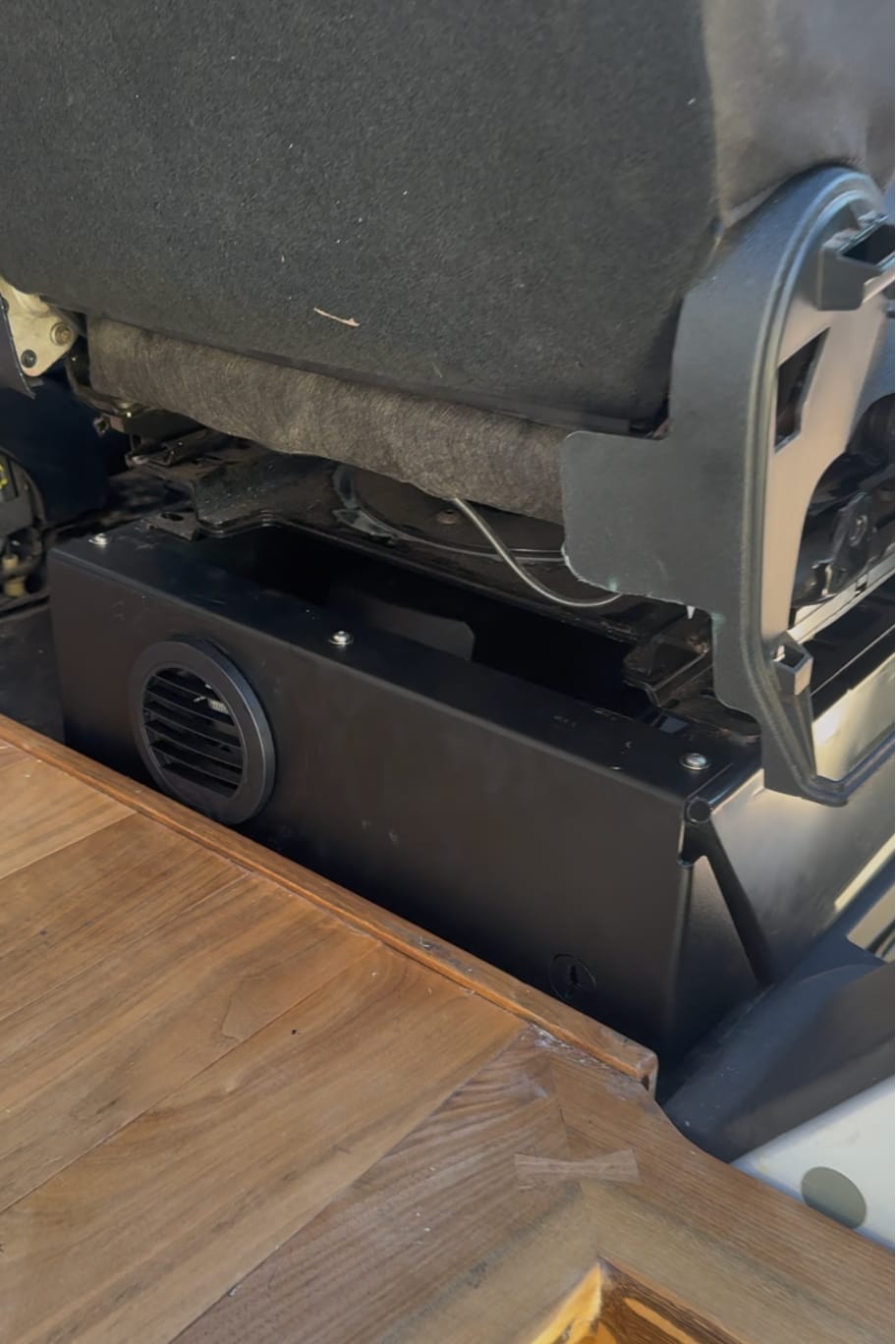
A diesel heater is the single best climate control investment you can make in a van conversion. It burns a tiny amount of diesel fuel to produce steady, dry heat that keeps the interior comfortable in any temperature. Unlike propane heaters, diesel heaters don’t add moisture to the cabin. Unlike electric heaters, they don’t drain your battery bank. Paired with proper insulation, a diesel heater keeps even an uninsulated metal box comfortable in freezing temperatures. And unlike running the van’s engine for heat, they use a fraction of the fuel.
If you are building a van you plan to use in anything other than perfect summer weather, you need a heater. This guide covers the three main options, what they cost, how installation works, and what we recommend based on years of building vans in Encinitas, CA.
How Diesel Heaters Work
A diesel heater is a self-contained combustion unit. Here is the basic process:
- A fuel pump draws diesel from a small tank (or tapped from the van’s fuel tank) through a fuel line to the heater
- The heater’s glow plug ignites the fuel in a sealed combustion chamber
- Fresh air is drawn from outside the van for combustion
- Exhaust gases exit through a pipe routed under the van — they never enter the cabin
- A separate blower fan pushes cabin air over a heat exchanger, warming it and blowing it into the living space
The key point: the combustion circuit and the cabin air circuit are completely separate. The air you breathe never touches the combustion process. This is what makes diesel heaters safe to run overnight while sleeping.
The Three Options: Webasto vs. Espar vs. Chinese
There are really only three categories of diesel heater used in van conversions. Here is an honest comparison.
Webasto
Webasto is a German manufacturer that has been making vehicle heaters for decades. Their Airtop 2000 STC is the most common model used in van conversions.
Specs:
- Heat output: 0.9 to 2.0 kW
- Fuel consumption: 0.03 to 0.07 gal/hr
- Electrical draw: 14 to 29W (fan motor)
- Weight: approximately 5.5 lbs
Pros:
- Excellent build quality and reliability
- Automatic altitude adjustment (works well above 8,000 feet)
- Extensive dealer and service network across North America
- Good warranty coverage
- Quiet operation
- Proven track record in commercial vehicles
Cons:
- Expensive: $1,200 to $1,800 installed
- Parts are pricier if something does need replacing
Cost: $800 to $1,200 for the unit. $400 to $600 for installation labor and materials (exhaust, intake, fuel line, controller, mounting).
Espar (Eberspacher)
Espar is another German manufacturer with a long history in vehicle heating. Their Airtronic S2 D2L is the direct competitor to the Webasto Airtop 2000.
Specs:
- Heat output: 0.9 to 2.2 kW
- Fuel consumption: 0.03 to 0.07 gal/hr
- Electrical draw: 14 to 29W
- Weight: approximately 5.5 lbs
Pros:
- Build quality on par with Webasto
- The newest third-generation Airtronic units are quieter than Webasto and heat faster
- Good altitude compensation
- Strong dealer network
- Good warranty
Cons:
- Similar price point to Webasto
- Slightly less common in the van conversion community (more common in trucking)
Cost: $800 to $1,200 for the unit. $400 to $500 for installation.
Chinese Diesel Heaters
Chinese diesel heaters are aftermarket units that replicate the basic design of Webasto and Espar heaters at a fraction of the price. They are sold on Amazon and eBay under dozens of brand names — Vevor, Hcalory, Wander, and many others.
Specs (typical 2kW unit):
- Heat output: up to 2.0 kW (claimed)
- Fuel consumption: similar to premium brands on paper
- Electrical draw: similar to premium brands on paper
- Weight: 5 to 7 lbs
Pros:
- Dramatically cheaper: $100 to $250 for a complete kit including exhaust, intake, fuel tank, and controller
- Easy to replace entirely if one fails
- Widely available and ship quickly
- Many van lifers have used them successfully for years
Cons:
- Inconsistent quality control — you might get a great unit or a problematic one
- No meaningful warranty or manufacturer support
- Most lack automatic altitude adjustment, leading to poor performance and error codes above 5,000 to 8,000 feet
- Noisier than premium units (both the fan and combustion sound)
- Parts are not standardized, making repairs harder
- Fuel pump quality varies, leading to inconsistent fuel delivery
Cost: $100 to $250 all-in for the complete kit.
Quick Comparison
| Feature | Webasto Airtop 2000 | Espar Airtronic D2 | Chinese 2kW |
|---|---|---|---|
| Price (unit only) | $800 to $1,200 | $800 to $1,200 | $100 to $250 |
| Price (installed) | $1,200 to $1,800 | $1,200 to $1,700 | $300 to $500 |
| Reliability | Excellent | Excellent | Variable |
| Altitude compensation | Automatic | Automatic | Usually none |
| Noise level | Low | Very low (3rd gen) | Moderate to loud |
| Warranty | 2 years | 2 years | Limited or none |
| Service network | Extensive | Extensive | None |
| Fuel efficiency | Very good | Very good | Good when working properly |
What We Install and Recommend
We spec Espar (Eberspacher) Airtronic heaters. The S3 D2L 2kW unit is our standard, and we step up to the M3 D4L 4kW when a van needs more output. We match the model to the fuel the vehicle already carries, so a diesel Sprinter gets the D-series and a gas ProMaster or Transit gets the B-series, both running off the vehicle’s own tank. That keeps a second fuel out of the build.
Webasto makes a good heater and there is nothing wrong with the brand. Espar is what we source through our supplier accounts, so it is what we install, stock parts for, and stand behind.
We don’t install Chinese diesel heaters in our professional builds. The inconsistent quality control is a liability issue, and we stand behind every system we install. For a professional build with a warranty, a premium heater is the right choice.
That said, if you are doing a DIY van conversion on a tight budget, a Chinese diesel heater is a reasonable option. Plenty of people use them without issues. Just go in with the understanding that you might need to troubleshoot it, you won’t have dealer support, and altitude performance may be limited.
Installation: What’s Involved
Installing a diesel heater requires cutting holes in the van floor, running fuel and exhaust lines underneath the vehicle, and wiring the heater into the electrical system. Here is what’s involved.
Mounting Location
The heater mounts under the van’s floor or inside a sealed compartment that draws combustion air from outside. The most common location is under the passenger area, mounted to the van’s underbody with the heat outlet ducted up through the floor into the cabin.
Exhaust Routing
The exhaust pipe must exit under the van and route away from the cabin. Key requirements:
- Exhaust must terminate away from any air intake, windows, or vents
- Route on a continuous downward slope so condensation drains out
- If any low points are unavoidable, drill a small drain hole (3/16 inch) at each low point to prevent water blockage
- Keep exhaust away from fuel lines and plastic components
- Secure all exhaust clamps tightly — a loose connection leaks carbon monoxide
Combustion Air Intake
The intake draws fresh air from outside the van for the combustion process. It must be located:
- Away from the exhaust outlet (so it doesn’t draw in its own exhaust)
- Away from the van’s engine exhaust
- In a location that won’t get blocked by mud, snow, or debris
Fuel Supply
The heater needs a fuel supply. Two options:
- Separate tank: A small 2 to 5 gallon diesel tank mounted in the van. Simple, independent, but requires separate refueling.
- Tapped from the van’s fuel tank: A fuel line runs from the van’s diesel tank to the heater. Convenient — the heater uses the same fuel as the engine. Only works if your van is diesel. For gas vans (note: the gas Sprinter was discontinued after 2023), you must use a separate diesel tank.
The fuel pump mounts inline between the tank and the heater. Install a fuel filter at the pump inlet. Secure all fuel connections tightly and check for leaks.
Electrical Connections
A diesel heater draws 14 to 29W while running (for the fan and fuel pump). It also needs a brief high-draw period at startup for the glow plug (about 40 to 80W for a minute or two). This is negligible compared to your other electrical loads.
Wire the heater to your house battery system with an appropriate fuse. The controller mounts inside the cabin — either a dial controller, a digital controller, or a smartphone-connected Bluetooth controller depending on the model.
Ducting
Hot air from the heater enters the cabin through ducting. A single outlet near the center of the living space works for most van conversions. Longer vans or builds with a separate bedroom area may benefit from split ducting with two outlets.
Safety Requirements
Diesel heaters are safe when installed correctly. But “installed correctly” matters. These are non-negotiable safety items:
Carbon Monoxide Detector
Required. Install a carbon monoxide detector in the living space. Even though the combustion circuit is sealed from the cabin, a cracked heat exchanger or loose exhaust connection could potentially leak CO. A detector is your backup.
Smoke and Fire Detection
Install a smoke detector. Keep a small ABC fire extinguisher within reach.
Exhaust Integrity
Check all exhaust connections and clamps before every season. A single loose clamp can leak exhaust gases under the van, which could seep into the cabin through floor penetrations.
Clearance
Maintain at least 2 inches of clearance around the heater body. Do not allow combustible materials (wood, fabric, insulation) to contact the heater or exhaust components.
Ventilation
Even though diesel heaters don’t add moisture to the cabin like propane does, you still need some ventilation while sleeping. Crack a roof vent or window slightly. This prevents CO2 buildup from breathing and keeps condensation manageable.
Fuel Consumption and Running Costs
One of the best things about diesel heaters is how little fuel they use.
| Setting | Fuel Use (gal/hr) | Hours Per Gallon | Cost Per Hour (at $4/gal diesel) |
|---|---|---|---|
| Low | ~0.03 | ~33 hours | ~$0.12 |
| Medium | ~0.05 | ~20 hours | ~$0.20 |
| High | ~0.07 | ~14 hours | ~$0.33 |
Running the heater on low overnight (8 hours) uses about a quarter gallon of diesel and costs roughly a dollar. For a full night of heat in freezing temperatures, that is remarkably cheap.
Compare that to running the van’s engine (1+ gallons per hour at idle) or an electric space heater (1,500W draining roughly 125 amps per hour from a 12V system — your batteries would be dead in two hours).
Other Heating Options
Diesel heaters are the best option for most van conversions, but they are not the only option.
Propane Forced-Air Heaters (Propex, Suburban)
Propane heaters like the Propex HS2000 burn propane instead of diesel. They work well and are popular in ProMaster conversions (which are gas-powered, so there’s no diesel fuel on board to tap).
Pros: Works in any van regardless of fuel type, propane is easy to refill. Cons: Propane adds moisture to the cabin, requires propane tank storage and lines, ongoing propane refill cost is higher than diesel.
Electric Heaters
Portable electric space heaters work on shore power but are impractical off-grid. A 1,500W heater would drain a 200Ah lithium battery bank in under two hours. Only viable if you are always plugged in.
Wood Stoves
Tiny wood stoves exist for vans and are popular in the overlanding community. They provide dry heat and ambiance but require a chimney, create fire risk, and need constant tending. Not practical for overnight heating while sleeping.
The Bottom Line
For any van conversion that will see cold weather — whether that means mountain camping in summer or winter van life — a diesel heater is the standard. It provides reliable, dry, efficient heat for pennies per hour, and it is safe to run all night.
If budget allows, go with a Webasto or Espar. If you are on a tight budget and willing to accept the trade-offs, a Chinese unit can work. Either way, proper installation is what matters most for safety and reliability.
Planning a van build? We include a diesel heater in nearly every conversion we build. Call us at (714) 257-5446 or email hello@emerycustombuilds.com to start planning your build.