
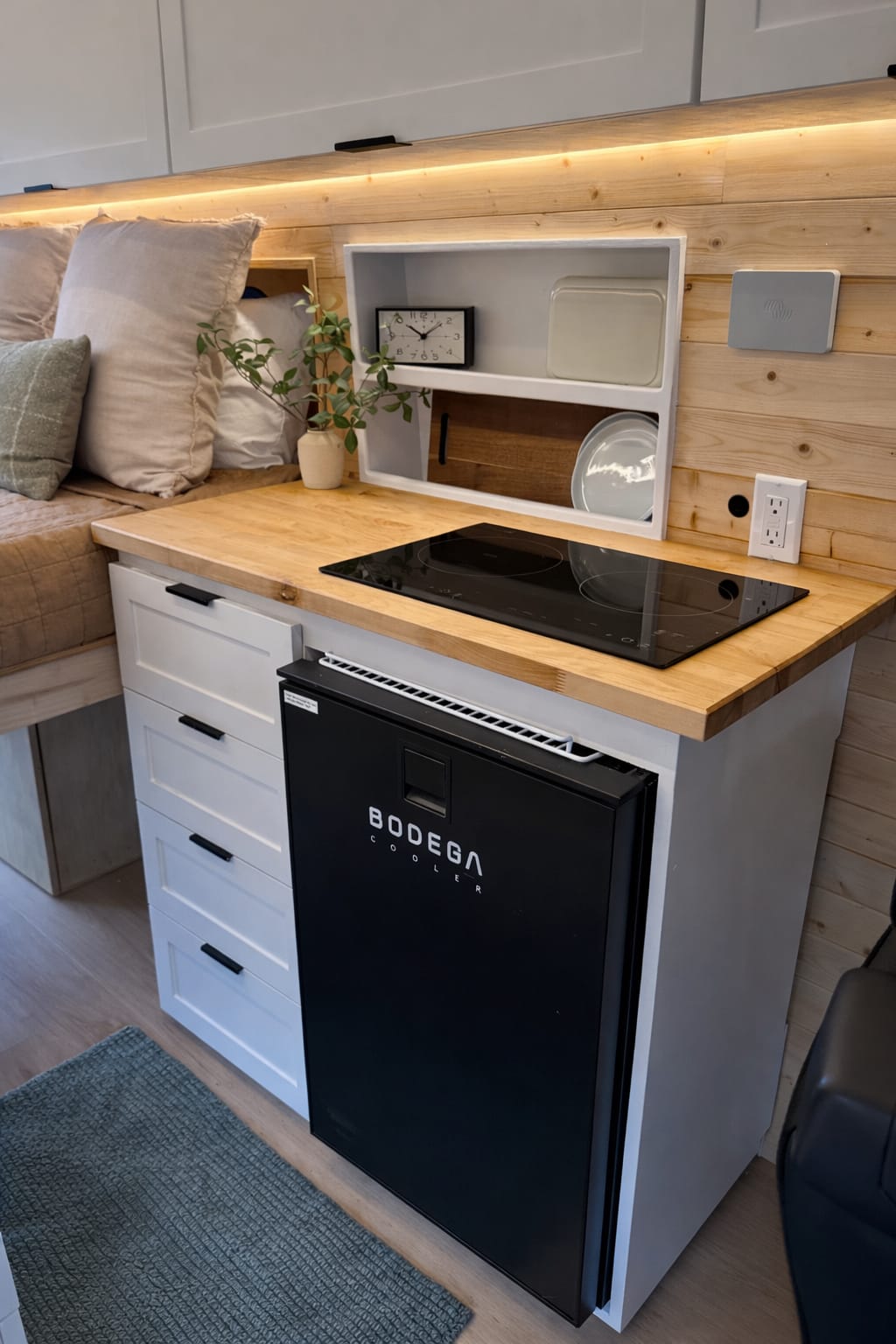
A 12V fridge is one of the most important components in any van conversion. It runs 24/7, it affects what you can eat and how long you can stay out, and it puts a constant load on your electrical system. Getting the right one matters more than most people realize when they start planning a build.
This guide covers everything you need to know about choosing a 12V fridge for your van. We compare the major brands with real prices, break down the differences between fridge styles, and explain how your fridge choice connects to the rest of your electrical system. If you are looking for a broader overview of van kitchen components, check out our camper van kitchen guide first.
Why 12V Compressor Fridges Are the Standard
There are three ways to keep food cold in a van: coolers with ice, thermoelectric coolers, and 12V compressor fridges. Only one of them actually works for anything beyond a weekend trip.
Coolers are fine for short trips but they need ice, they don’t maintain a consistent temperature, and everything ends up sitting in water. If you are building a van for regular travel or full-time living, a cooler is not a real solution.
Thermoelectric coolers (Peltier-style) are cheap, but they can only cool about 30 to 40 degrees below ambient temperature. On a 95-degree day, the inside of the cooler is still above 55 degrees. That is not refrigeration. We don’t install them and we don’t recommend them.
12V compressor fridges work like a household fridge. A compressor, refrigerant, thermostat, and insulated box keep your food at a set temperature regardless of how hot it is outside. They run directly off your van’s 12V battery bank, draw relatively low power, and maintain consistent temperatures. This is what every serious van conversion uses, and it is the only option we install.
Top-Loading vs Front-Opening Fridges
This is the first decision you need to make, and it affects your kitchen layout, your power draw, and how you interact with the fridge every day.
Top-Loading (Chest Style)
Top-loading fridges open from the top like a chest. Cold air is heavier than warm air, so when you open the lid, the cold stays in the box instead of spilling out onto the floor. This makes them meaningfully more energy efficient than front-opening models.
Advantages:
- 10 to 25 percent more efficient than front-opening fridges
- Simple, reliable design with fewer moving parts
- Many models offer dual-zone (fridge and freezer) in one unit
- Easy to slide into a cabinet opening or dedicate floor space
Disadvantages:
- Harder to organize and find items (you are digging through layers)
- Need clear space above the lid to open it
- Cannot stack items on top of the fridge
- Less convenient for daily use compared to an upright fridge
Best for: Overlanders, off-grid travelers, weekend warriors, and anyone who prioritizes power efficiency over kitchen convenience. Also a good fit if you have limited electrical capacity.
Front-Opening (Upright)
Front-opening fridges look and work like a small household fridge. They have shelves, door bins, and sometimes a small freezer compartment. They integrate into cabinetry for a clean, built-in look.
Advantages:
- Easy to organize with shelves and door storage
- Built-in installation creates a polished kitchen look
- Can use the top surface as counter space
- More intuitive daily use
Disadvantages:
- Cold air falls out every time you open the door
- Slightly higher power draw than top-loaders
- Door swing requires clearance in front of the fridge
- Hinges and door seals can wear over time with van vibration
Best for: Full-time van lifers, couples who cook regularly, and anyone building a kitchen that feels like a real kitchen. This is what we install in most of our builds.
Brand Comparison
Here is an honest breakdown of the major 12V fridge brands we see in the van world. These are real street prices as of 2026.
Dometic CFX3 Series (Top-Loading)
The Dometic CFX3 is the most popular 12V fridge in the van and overlanding world, and for good reason. Sizes range from 36L to 95L. They have WiFi app monitoring, low-power shutdown protection, and solid build quality.
- Sizes: 36L, 45L, 55L, 65L, 75L, 95L
- Price range: $700 to $1,400
- Power draw: Efficient. The 55L model averages about 1.5 to 2.5 amps
- Standout feature: WiFi app lets you monitor and adjust temperature from your phone
- Our take: Hard to go wrong with a CFX3. The 55L is the sweet spot for most van builds. Pricey, but you get what you pay for.
Dometic CRX Series (Front-Opening, Built-In)
The CRX line is purpose-built for marine and van installations. These are designed to be mounted into cabinetry with a front-opening door. They come with reversible door hinges and a flush-mount frame.
- Sizes: 50L, 65L, 80L
- Price range: $800 to $1,500
- Power draw: Moderate. Slightly higher than the CFX due to door style
- Standout feature: Built specifically for built-in cabinetry with proper ventilation specs
- Our take: This is what we install in most of our built-in kitchen setups. It looks clean, it works well, and it is designed for the job. The 50L CRX is our go-to for couples.
Engel (Top-Loading)
Engel has been around longer than most of these brands and has a reputation for being nearly indestructible. Their swing motor compressor is unique in the industry and extremely reliable. The downside is they are heavy and the styling is dated.
- Sizes: 40L, 60L, 80L
- Price range: $800 to $1,200
- Power draw: Excellent efficiency. The swing motor compressor is one of the most efficient on the market
- Standout feature: Legendary reliability. People run these for 10+ years without issues
- Our take: If you want a fridge that will outlast your van, Engel is hard to beat. The weight is the main trade-off, and they don’t have fancy app features. But they just work.
ARB (Top-Loading)
ARB is an Australian overlanding brand that makes solid, well-built top-loading fridges. Popular in the 4x4 and overland community. Not as common in the van world as Dometic but well-regarded.
- Sizes: 37L, 50L, 63L, 73L
- Price range: $700 to $1,100
- Power draw: Good. Competitive with Dometic
- Standout feature: Built tough for off-road use with reinforced corners and heavy-duty latches
- Our take: A solid choice, especially if you are overlanding. The build quality is excellent. Not quite as refined as Dometic in terms of features, but reliable and well-supported.
Isotherm Cruise (Front-Opening, Built-In)
Isotherm is a European brand (Italian-made) with a strong reputation in the marine industry. Their Cruise line is specifically designed for built-in installations with a range of sizes and a clean aesthetic.
- Sizes: 42L, 65L, 85L, 100L, 130L
- Price range: $600 to $1,200
- Power draw: Good. Danfoss/Secop compressors are efficient and proven
- Standout feature: Wide range of sizes and configurations. Great for custom cabinet builds
- Our take: A solid alternative to the Dometic CRX, especially if you want a larger built-in fridge. Well-made, good compressor, and the larger models are a real option if you have the space.
Vitrifrigo (Front-Opening, Built-In)
Another Italian brand with marine roots. Vitrifrigo makes competent built-in fridges at a lower price point than Dometic or Isotherm. They won’t win any style awards, but they get the job done.
- Sizes: 42L, 65L, 85L, 115L
- Price range: $500 to $1,000
- Power draw: Decent. Slightly higher than Isotherm or Dometic
- Standout feature: Lowest price point for a legitimate built-in 12V fridge
- Our take: If your budget is tight but you want a real built-in fridge, Vitrifrigo is worth considering. Not as polished as the Dometic CRX or Isotherm Cruise, but functional and much cheaper.
Alpicool and Bodega (Top-Loading, Budget)
These are Chinese-manufactured budget fridges that have gotten surprisingly popular. They work, they cool, and they cost a fraction of the name brands. But the build quality, insulation, and compressor efficiency are noticeably lower.
- Sizes: 15L to 75L (huge range of models)
- Price range: $200 to $500
- Power draw: Higher than comparable Dometic or Engel models. Insulation is thinner, so the compressor runs more often
- Standout feature: Price. You can get a functional 12V fridge for under $300
- Our take: Decent for a first van build on a budget, weekender use, or as a secondary cooler. We wouldn’t rely on one for full-time van life. If you can stretch your budget to an Isotherm, Vitrifrigo, or used Dometic, you will be happier long-term.
Cost Comparison Table
| Brand | Style | Size Range | Price Range | Best For |
|---|---|---|---|---|
| Dometic CFX3 | Top-loading | 36–95L | $700–$1,400 | Most popular all-around choice |
| Dometic CRX | Front-opening | 50–80L | $800–$1,500 | Built-in van kitchens |
| Engel | Top-loading | 40–80L | $800–$1,200 | Maximum reliability |
| ARB | Top-loading | 37–73L | $700–$1,100 | Overlanding and off-road |
| Isotherm Cruise | Front-opening | 42–130L | $600–$1,200 | Built-in, larger sizes |
| Vitrifrigo | Front-opening | 42–115L | $500–$1,000 | Budget built-in option |
| Alpicool/Bodega | Top-loading | 15–75L | $200–$500 | Budget or secondary fridge |
Sizing: How to Choose the Right Capacity
Fridge size depends on how you travel, how many people you are feeding, and how often you resupply.
Weekend trips (solo or couple): 35 to 45 liters is plenty. You can fit drinks, a couple days of food, and condiments without much trouble. A Dometic CFX3 36L or similar works great.
Regular travel (couple): 45 to 55 liters. Enough for 3 to 4 days of groceries for two people. This is the most common size range we install. The Dometic CFX3 55L or CRX 50L hits the sweet spot.
Full-time van life (couple): 50 to 65 liters. You want room to stock up at a grocery store without playing Tetris every time. A larger Dometic CRX 65L or Isotherm Cruise 65L gives you breathing room.
Family or extended off-grid: 65 to 80+ liters, or consider a fridge plus a separate small freezer. At this point, you need to think seriously about your electrical system capacity because a larger fridge draws more power.
Keep in mind that stated liter capacity includes the freezer compartment on dual-zone models. The actual fridge space is smaller than the headline number.
Power Consumption and Battery Sizing
Your fridge is the single largest continuous electrical load in most van builds. Understanding the power draw is critical for sizing your battery bank and solar system.
Typical power draw: 1 to 4 amps average at 12V. The compressor cycles on and off, so the instantaneous draw when the compressor is running is higher (4 to 6 amps), but the average over 24 hours is much lower.
Daily consumption: 30 to 60Ah per day depending on:
- Ambient temperature (hotter = more compressor runtime)
- How often you open the fridge
- How full the fridge is (a full fridge holds temperature better)
- Insulation quality of the fridge itself
- Set temperature
What this means for your electrical system:
A 200Ah lithium battery bank gives you roughly 180Ah of usable capacity (discharging to 10%). If your fridge draws 40Ah per day, that is about 22% of your usable battery capacity just for the fridge. Add lights, fans, phone charging, and a water pump, and you can see why solar matters so much.
Minimum recommended setup to run a 12V fridge full-time:
- 200Ah lithium battery bank
- 200W of solar (minimum)
- Alternator charging as a backup (DC-DC charger)
For a detailed breakdown of how to size your electrical system around your fridge and other loads, check out our lithium battery guide.
Installation: Built-In vs Freestanding
How you install the fridge depends on whether you chose a top-loading or front-opening model, and what kind of kitchen layout you are building.
Freestanding (Top-Loading)
A top-loading fridge sits on the floor of the van, usually in or near the kitchen area. It can slide into a cabinet opening or sit in a dedicated space with straps or brackets holding it in place.
Key installation points:
- Secure it for travel. A 50-pound fridge becomes a projectile in a hard stop. Use ratchet straps, L-brackets, or a dedicated cabinet surround
- Ventilation. Leave at least 2 inches of clearance around the compressor area (usually the back or side) for heat dissipation
- Power connection. Run a dedicated 12V circuit from your fuse box to the fridge location. Use 10 AWG wire for runs over 10 feet to minimize voltage drop
- Accessibility. Make sure the lid can open fully. Overhead cabinets that block the lid are a common design mistake
Built-In (Front-Opening)
A front-opening fridge installs into cabinetry, typically with a flush-mount frame kit that matches the fridge model. This gives the kitchen a polished, finished look.
Key installation points:
- Use the manufacturer’s flush-mount kit. Dometic CRX and Isotherm Cruise models have specific frame kits designed for built-in installation. Don’t try to improvise this
- Ventilation is critical. Built-in fridges need airflow behind and above the unit. Most manufacturers specify minimum clearances. Inadequate ventilation makes the compressor work harder and shortens its life
- Door swing. Make sure the door opens far enough to remove shelves and clean the interior. Plan the hinge side based on your kitchen layout
- Leveling. Compressor fridges work best when reasonably level. Van floors are not always flat, so shim the fridge during installation if needed
Features That Actually Matter
Not every feature on a spec sheet is worth paying for. Here is what we think matters and what doesn’t.
Worth paying for:
- Dual zone (fridge + freezer): Having a separate freezer compartment is genuinely useful. You can freeze meat, keep ice cream, and store items that need to stay frozen without affecting the fridge section
- Low-voltage cutoff: Protects your battery bank by shutting off the fridge before the batteries drop too low. Most quality brands include this
- Removable baskets/dividers: Makes organization in top-loading fridges much easier. Worth having
- Drain plug: For cleaning and defrosting. Simple but important
- USB port: Some Dometic models have a USB port on the fridge for charging devices. Handy if you don’t have outlets nearby
Not worth paying extra for:
- WiFi/Bluetooth app monitoring: It sounds cool, but how often are you actually going to check your fridge temperature on your phone? The Dometic app works fine, but it is not a reason to pick one model over another
- Fancy digital displays: A basic thermostat dial works just as well as a digital touchscreen. More electronics means more things that can break
- Multiple compressor speed settings: Marketing language. The thermostat handles compressor cycling automatically. You don’t need to manually adjust compressor speed
- Built-in battery: Some portable models include a small internal battery. It is too small to be useful and adds weight and cost
What We Install
At Emery Custom Builds, we have installed a lot of fridges across Sprinter, Transit, and ProMaster builds. Here is what we use and why.
For built-in kitchens (built-in kitchens): Dometic CRX series. The CRX 50L is our go-to for couples, and the CRX 65L for people who want more room. It integrates cleanly into our custom cabinetry, has proper ventilation specs, and holds up to van life. We have also installed Isotherm Cruise units when customers have specific size or budget requirements.
For freestanding setups (freestanding setups): Dometic CFX3 series. The CFX3 55L is the most popular. It slides into a cabinet or floor space, gets strapped down, and just works. For budget builds, we will work with whatever the customer brings, but we always recommend spending at least $600 on a fridge.
Every fridge installation includes a dedicated 12V circuit, proper fusing, adequate wire sizing, and secure mounting. The fridge ties into the overall electrical system we design for each build.
Want to see how we integrate fridges into real van kitchens? Take a look at our completed builds. Every kitchen is designed around how the owner actually plans to use the van.
Making the Decision
If you are still deciding, here is the simple version:
- Set your budget. Under $500, look at Alpicool or Bodega for a starter fridge. $600 to $1,000, look at ARB, Isotherm, or Vitrifrigo. Over $1,000, Dometic or Engel.
- Pick your style. Top-loading for efficiency, front-opening for convenience and a built-in look.
- Size it right. 45 to 55 liters covers most couples. Go bigger if you travel with family or stay off-grid for extended stretches.
- Check your electrical system. Make sure your battery bank and solar can support the fridge plus everything else you run. Our solar guide and battery guide can help with the math.
The fridge is a long-term investment. A good 12V compressor fridge will last 5 to 10+ years with basic care. Spend a little more upfront and you won’t think about it again.
For a full breakdown of what a van conversion costs across all systems, check out our van conversion cost guide.
Planning a van conversion and want help choosing the right fridge and kitchen setup? Tell us about your build and we’ll get back to you with a custom estimate.