
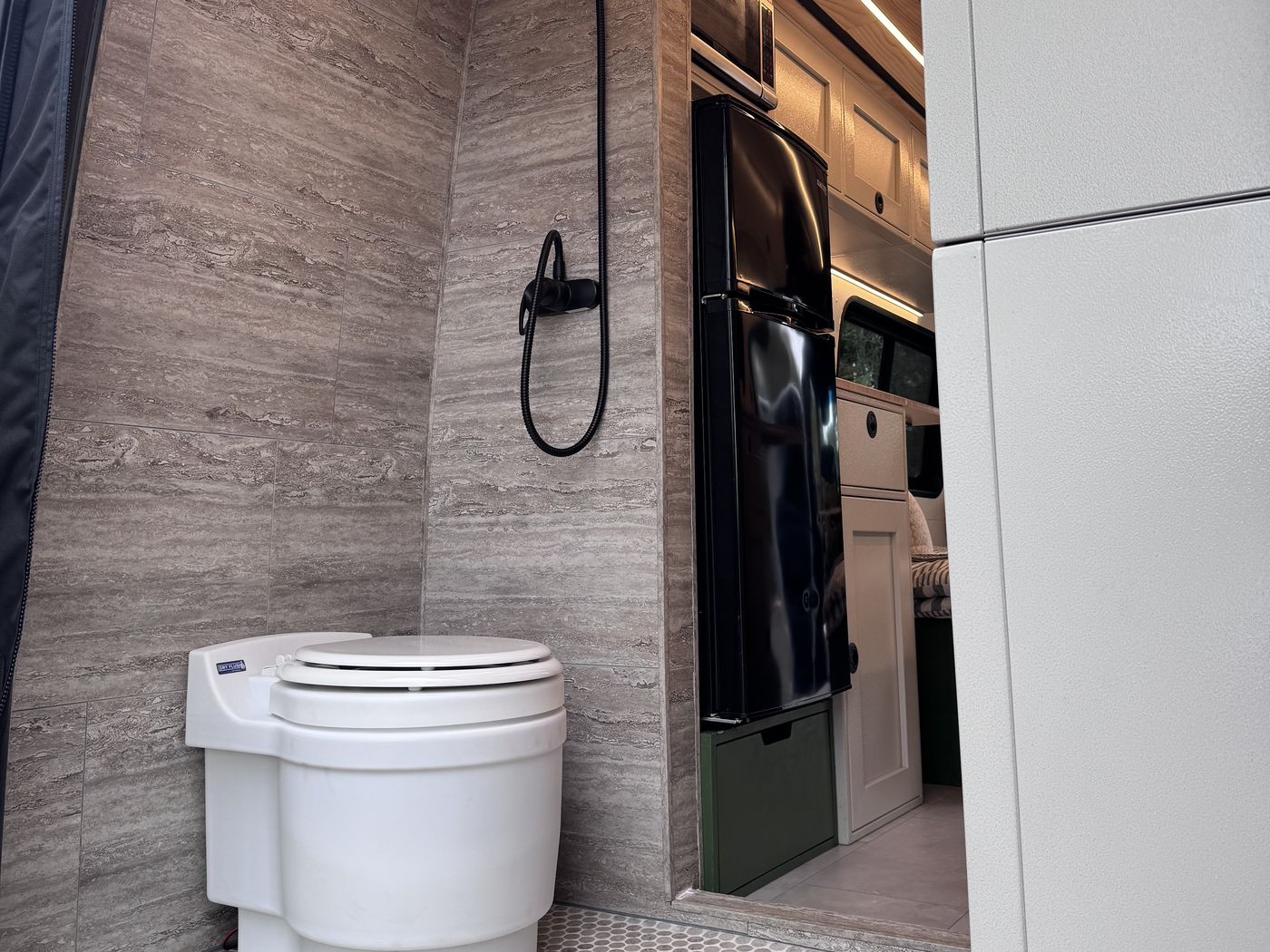
Having a shower in your van changes the way you travel. Without one, you are constantly looking for campground bathrooms, gym memberships, or truck stops. With one, you can camp anywhere for as long as you want and still feel like a human being. A van life shower does not need to be complicated or expensive, but it does need to be planned properly or you end up with leaks, mold, or a setup that wastes your freshwater supply in two showers.
This guide covers every decision you need to make: indoor vs outdoor, wet bath vs dry bath layout, how to get hot water, plumbing basics, drainage into your greywater system, and what we actually install in our builds.
Indoor vs. Outdoor Showers
This is the first decision, and it affects everything else about your build.
Outdoor Showers
An outdoor shower is the simplest option. A handheld sprayer mounted on the outside of the van (or on a swing-out arm on the rear doors) connects to your freshwater system. You stand outside, rinse off, done.
When an outdoor shower makes sense:
- You mostly travel in warm climates
- You use the van for weekend trips and surf/mountain bike/climb where you just need to rinse off
- You don’t want to give up any interior space for a bathroom
- Budget is tight and you want to keep the build simple
The downsides:
- Useless in cold or rainy weather
- No privacy unless you rig up a curtain or pop-up enclosure
- Water goes on the ground, which is fine in some locations and not okay in others
- No way to contain greywater for areas with strict rules
- You are standing outside wet and naked, which gets old
An outdoor shower works as a supplement to an indoor setup. We install exterior sprayers on a lot of builds even when there is a full indoor shower, because they are great for rinsing gear, washing dogs, or cleaning off sandy feet before getting back in the van.
Indoor Showers
An indoor shower means a dedicated waterproof space inside the van with a drain, hot water, and a way to contain the spray. This is what most people who plan to spend serious time in their van actually want. It costs more and takes more planning, but the convenience is worth it.
The two main approaches are a wet bath and a dry bath, which we will cover next.
Wet Bath vs. Dry Bath Design
Wet Bath
A wet bath is a single enclosed space that serves as both your shower and your toilet room. The entire room is waterproofed — walls, floor, and door. When you shower, everything in the room gets wet, including the toilet. When you are not showering, the space functions as a toilet room and general storage area.
Why most van builds use a wet bath:
- Takes up the least floor space (typically 24 by 30 inches in a standard Sprinter)
- The space does double duty — shower and toilet in one footprint
- Works in 144-inch wheelbase vans where space is tight
- Simpler to waterproof one contained area than separate zones
The trade-offs:
- Everything in the room gets wet when you shower
- You need to wipe down the toilet and any stored items after showering (or use a toilet cover)
- The room needs time to dry between shower use and toilet use
- Ventilation is critical to prevent mold and moisture buildup
A wet bath in a Sprinter or Transit is typically located in the rear corner of the van, next to the rear doors. This keeps the plumbing runs short and puts the heavy water tanks toward the rear axle. We build most of our wet baths with FRP (fiberglass reinforced plastic) walls, a one-piece fiberglass shower pan, and a sliding or folding door.
Dry Bath
A dry bath separates the shower from the toilet area. You get a dedicated shower stall and a separate toilet room (or at least a partition keeping the toilet dry). This is closer to what you would find in a house.
When a dry bath works:
- You have a longer van — 170-inch wheelbase Sprinter or extended Transit/ProMaster
- Bus conversions or trailer conversions where floor space is less of a constraint
- You prioritize the shower experience and don’t want to wipe down the toilet every time
The trade-offs:
- Takes significantly more floor space than a wet bath
- Adds weight (more walls, more waterproofing material)
- Not practical in a 144-inch wheelbase van without major compromises elsewhere in the layout
For more on how the bathroom fits into the overall layout, check out our bathroom design guide.
Hot Water Options
Getting hot water to your shower is the part that trips up a lot of DIY builders. There are three main approaches, each with different trade-offs in cost, complexity, space, and energy use.
1. Tankless Propane Water Heater
This is the most popular option in van conversions and the one we install in most of our builds. A tankless unit mounts on an exterior wall or inside a vented compartment. When you turn on the hot water faucet, the unit ignites a propane burner and heats water as it flows through a heat exchanger. When you turn the water off, it shuts down.
Popular models: Camplux 5L ($140 to $180), Eccotemp L5 ($150 to $200), Camp Chef Triton (~$200 to $250).
Pros:
- On-demand hot water with no waiting
- No electricity from your battery bank (propane-powered ignition)
- Compact and lightweight
- Endless hot water as long as you have propane and freshwater
- Affordable
Cons:
- Requires propane (an additional system to manage)
- Must be mounted with access to outside air for combustion and exhaust
- Can struggle with very low flow rates (some units have a minimum flow to activate)
- Water temperature can fluctuate slightly with flow changes
2. 12V Tank Water Heater
A tank heater stores 2 to 6 gallons of water and heats it using a 12V electric element. You heat the water before you need it, then use it like a normal hot water tap.
Pros:
- No propane required — runs entirely off your electrical system
- Consistent water temperature
- Simple installation — just a tank with inlet, outlet, and a power connection
- Good for propane-free builds
Cons:
- Uses a lot of power (typically 200 to 400 watts to heat, which adds up)
- Takes 20 to 60 minutes to heat depending on tank size and starting water temperature
- Heavy when full (a 6-gallon tank weighs over 50 lbs with water)
- Limited hot water — once the tank is empty, you wait for it to reheat
- Requires a battery bank that can handle the draw (300Ah+ lithium recommended)
3. Diesel Heat Exchanger (Hydronic)
If your van has a diesel heater, some systems can double as a hot water source. A hydronic diesel heater (like the Webasto Thermo Top or an aftermarket heat exchanger) circulates coolant through a loop that heats both the cabin air and a small hot water tank.
Pros:
- Uses diesel from the van’s fuel tank — no separate propane
- Heats cabin and water from one system
- Very efficient in cold weather when you are already running the heater
Cons:
- Expensive ($2,000 to $4,000+ for a hydronic system)
- Complex installation with coolant lines, a circulation pump, and a heat exchanger
- Only practical if you are already planning a diesel heating system
- Overkill for warm-weather-only use
Hot Water Comparison
| Feature | Tankless Propane | 12V Tank Heater | Diesel Heat Exchanger |
|---|---|---|---|
| Cost | $140 to $250 | $200 to $500 | $2,000 to $4,000+ |
| Fuel Source | Propane | 12V battery bank | Diesel (vehicle tank) |
| Hot Water Delivery | On-demand, continuous | Limited to tank size (2-6 gal) | On-demand once heated |
| Warm-Up Time | Instant | 20 to 60 minutes | 10 to 20 minutes |
| Power Draw | None (propane ignition) | 200 to 400W while heating | Minimal (12V pump) |
| Weight | 5 to 10 lbs | 20 to 55 lbs (full) | 15 to 25 lbs (unit only) |
| Complexity | Low to moderate | Low | High |
| Best For | Most van builds | Propane-free builds | Cold-climate builds with diesel heat |
For most builds, a tankless propane heater is the right answer. It is affordable, reliable, light, and gives you hot water whenever you want it without draining your batteries. The 12V tank option makes sense if you are building a fully electric system with a large battery bank and want to avoid propane entirely. The hydronic route is a premium choice that really only makes sense if you are already investing in a diesel hydronic heating system for cold-weather use.
Plumbing Basics for a Van Shower
The plumbing for a van shower is not as complicated as people make it. Here is what you need:
Water Supply
Your shower connects to the same freshwater system as your kitchen sink. A 12V water pump (Shurflo 4008 is the standard in van builds) pressurizes the system. When you open a faucet or the showerhead, the pump kicks on and pushes water through the lines.
Lines: PEX tubing is the standard. It is flexible, easy to work with, and handles the vibration of a vehicle. We use 1/2-inch PEX for main lines. Connections are typically crimp fittings or push-to-connect (SharkBite style). PEX handles freezing better than rigid pipe — it has some flex before it cracks — but it is still not freeze-proof.
Hot and cold lines: You run separate PEX lines for hot and cold from the water heater and freshwater tank to a mixing valve or the showerhead. A thermostatic mixing valve gives the most consistent temperature, but a standard two-handle setup works fine too.
Showerhead
Use a handheld showerhead with a flexible hose and a thumb shutoff valve. The thumb shutoff lets you stop the flow while you lather up without having to adjust the temperature again. This is the single biggest water-saving trick in a van shower.
A low-flow showerhead at 1.5 GPM (gallons per minute) is plenty of pressure for a good shower while conserving water. Oxygenics and ETL brand showerheads are common in van builds.
Shower Pan and Walls
The shower floor needs to be waterproof and sloped toward a drain. Options include:
- One-piece fiberglass shower pan: The cleanest option. You can get custom or standard RV pans that fit common van widths. We use these in most builds.
- Tiled shower floor: Looks great but adds weight, complexity, and potential failure points with grout cracking from vehicle vibration. Not recommended for most vans.
- FRP-lined plywood: Fiberglass reinforced plastic over a plywood subfloor with sealed seams. Works well for custom shapes.
Walls should be waterproof from floor to ceiling. FRP panels are the industry standard for van wet baths. They are lightweight, waterproof, easy to clean, and hold up to the vibration of driving. Solid surface panels (Corian-style) look more residential but cost and weigh more.
Drainage and Greywater
Shower water needs somewhere to go. The drain in your shower pan connects to your greywater tank mounted underneath the van.
The Basics
- Drain fitting: A standard shower drain with a strainer to catch hair
- P-trap or check valve: Prevents tank odors from coming up through the drain. A traditional P-trap works but can freeze in winter. An inline check valve (like a Studor vent or HepvO valve) is a better solution for van use
- Drain line: 1-inch or 1.5-inch flexible hose from the drain to the greywater tank
- Greywater tank: Typically 15 to 30 gallons, mounted under the van. Sized to roughly match or exceed your freshwater tank capacity
- Tank drain: A gate valve or ball valve on the bottom of the greywater tank lets you empty it at dump stations or designated areas
Keeping It Working
The main enemies of a van shower drain are hair clogs and freezing. A hair strainer in the drain catches most debris. For cold weather, insulating exposed drain lines and the greywater tank helps. Some builders add a small tank heater pad to prevent freezing, but most people just dump the greywater tank before temperatures drop below freezing.
Slope matters. The shower pan needs at least 1/4 inch per foot of slope toward the drain, and the drain line to the tank should run downhill the entire way. Any low spots in the drain line will hold water and eventually smell.
Ventilation and Moisture Control
A shower produces a lot of moisture in a very small space. Without proper ventilation, that moisture goes into your walls, ceiling, and insulation, and you end up with mold.
What you need:
- An exhaust fan in the wet bath area. A small 12V fan vented through the wall or roof pulls humid air out. This can be a dedicated bathroom fan or a nearby roof vent (like a MaxxFan) positioned to draw air from the bathroom area.
- A door or curtain that allows airflow after showering. Leave the bathroom open after you shower to let it dry.
- Waterproof wall and ceiling materials. FRP panels, marine-grade finishes, or other non-porous surfaces that don’t absorb moisture.
If your van has a good climate control setup with a MaxxFan or similar roof vent, running it on exhaust after showers pulls moisture out of the van fast. This is not optional. Skipping ventilation is how people end up with mold problems.
What We Install at ECB
At Emery Custom Builds, we include a full indoor wet bath in most of our builds. Here is what a typical shower setup looks like in one of our conversions:
- Wet bath enclosure with FRP walls, a one-piece fiberglass shower pan, and a folding or sliding door
- Camplux 5L tankless propane water heater mounted on the exterior wall with proper ventilation
- Handheld showerhead with a flexible hose and thumb shutoff valve
- 1/2-inch PEX plumbing with crimp fittings for hot and cold lines
- Shurflo 4008 water pump feeding the entire plumbing system
- Floor drain plumbed to an underfloor greywater tank with a gate valve
- Dedicated exhaust ventilation to manage humidity
Every shower installation is designed around the specific van platform and layout. A Sprinter 144 wet bath looks different from a Transit 148 or a ProMaster 159. We plan the plumbing, drainage, and ventilation as part of the full build, not as an afterthought.
For builds where the customer does not want a full indoor shower, we install an exterior shower sprayer as a standard feature. It connects to the hot water system, mounts on the rear or side of the van, and works well for rinsing off after beach days or hikes.
Planning Your Van Shower: Quick Decision Guide
- Full-time van life or extended trips? Indoor wet bath with a tankless propane water heater. This is the setup that 90% of serious van lifers end up wanting.
- Weekend warrior, warm climates only? An outdoor shower or a simple indoor wet bath. You can always upgrade later, but the plumbing is easier to plan from the start.
- Want a residential shower feel? A dry bath in a long-wheelbase van. You need the space, but it is the most comfortable daily-use setup.
- Budget build? An outdoor sprayer with a portable propane camp shower heater is the cheapest way to get hot water. Not glamorous, but functional.
- Propane-free build? A 12V tank water heater with a 300Ah+ lithium battery bank. Make sure your electrical system can handle the draw.
The biggest mistake people make with van showers is not planning the plumbing and drainage from the start. Retrofitting a shower into a finished build means tearing out cabinetry and flooring to run drain lines. Get it right in the design phase and the installation is straightforward.
Ready to plan your van conversion with a proper shower setup? We build custom vans in San Diego, CA, and plumbing is one of the systems we spend the most time getting right. Call us at (714) 257-5446 or email hello@emerycustombuilds.com to start planning your build.