
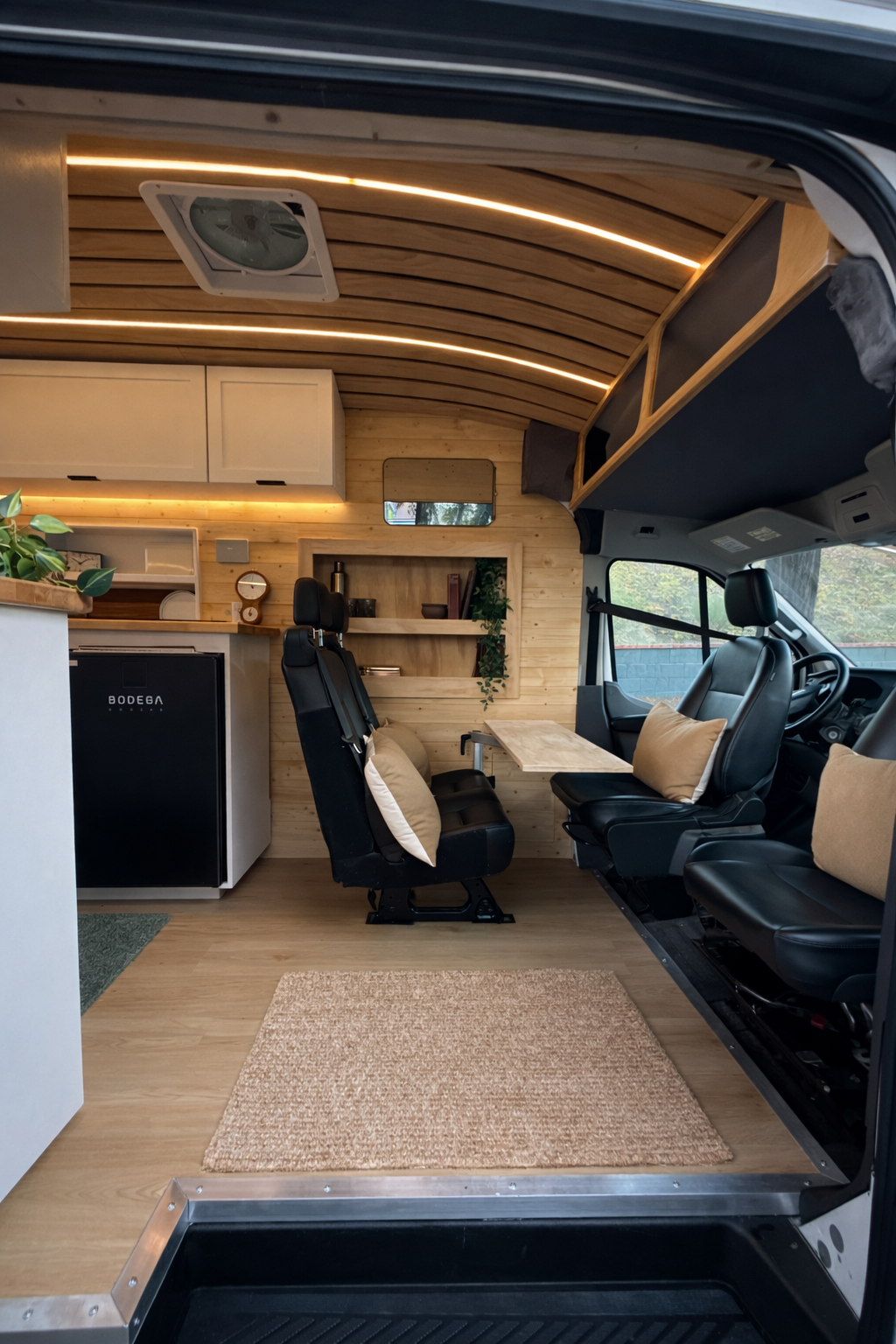
Choosing the right Ford Transit configuration is one of the most important decisions you will make before starting a van conversion. The Ford Transit dimensions vary significantly depending on which roof height and wheelbase you pick, and those numbers directly affect your layout, headroom, stealth potential, and build cost.
We build Ford Transit conversions in our Encinitas, CA shop, and the dimension questions come up in almost every consultation. This guide breaks down every Transit configuration with real interior measurements, including what you actually get after insulation and flooring take up some of that space.
Ford Transit Configurations Overview
Ford offers the Transit in three roof heights and three wheelbase lengths. Not every combination is available, but the range covers everything from compact cargo haulers to full-time live-in conversions.
Here is how the options break down:
Roof Heights:
- Low Roof
- Medium Roof
- High Roof
Wheelbases:
- 130 inches (short)
- 148 inches (long)
- 148 inches Extended (long body with extended rear overhang)
The extended body adds about 28 inches of cargo length behind the rear axle compared to the standard 148-inch wheelbase. Same wheelbase, longer cargo area.
Not every roof pairs with every body. The 130-inch wheelbase comes in low or medium roof, the 148-inch wheelbase comes in low, medium, or high roof, and the 148-inch extended body is offered in high roof only. There is no medium-roof extended Transit, so if you want the longest cargo floor, you are getting the high roof with it.
Ford Transit Interior Dimensions by Configuration
| Configuration | Factory Interior Height | Interior Width (max) | Width Between Wheel Wells | Cargo Length Behind Front Seats |
|---|---|---|---|---|
| 130” WB / Low Roof | ~57” | ~70” | ~55” | ~126” |
| 130” WB / Medium Roof | ~72” | ~70” | ~55” | ~126” |
| 148” WB / Low Roof | ~57” | ~70” | ~55” | ~144” |
| 148” WB / Medium Roof | ~72” | ~70” | ~55” | ~144” |
| 148” WB / High Roof | ~81.5” | ~70” | ~55” | ~144” |
| 148” Ext / High Roof | ~81.5” | ~70” | ~55” | ~172” |
These are approximate factory specs. The exact numbers can shift slightly by model year and trim, but they have remained consistent across the 2015-present Transit generations.
Ford Transit Exterior Dimensions
Exterior height matters for parking garages, ferries, and stealth camping. Here is the quick reference:
| Roof Height | Approximate Exterior Height | Fits Standard Parking Garage? |
|---|---|---|
| Low Roof | ~6’10” (82”) | Yes |
| Medium Roof | ~8’5” (101”) | Some (8’6”+) |
| High Roof | ~9’2” (110”) | No (most garages) |
At about 8’5” exterior height, the medium roof clears most parking structures with 9-foot ceilings and some with 8’6” clearance, but it won’t fit in standard 7-foot or 8-foot garages. It’s still significantly lower than the high roof, which makes it easier to navigate overpasses and clearance-restricted areas. The high roof at about 9’2” will not clear most garages, and adding a roof rack or vent fan pushes it even taller.
Ford Transit Overall Length
Total exterior length matters for parking, garages, and how the van drives day to day. The three bodies span nearly four feet from shortest to longest:
| Body | Overall Exterior Length | Wheelbase |
|---|---|---|
| Regular (130” WB) | ~219.9” (~18’4”) | 130” |
| Long (148” WB) | ~235.5” (~19’7”) | 148” |
| Extended (148” Long-EL) | ~263.9” (~21’11”) | 148” |
Note that the long and extended bodies share the same 148-inch wheelbase. The extended version adds its length as rear overhang behind the axle, not between the wheels, so the two drive and turn almost the same despite the extended body being over two feet longer overall. Exterior width is the same across all bodies at about 81 inches (without mirrors).
Roof Height Breakdown: What Each One Actually Gets You
Low Roof (~57” Interior Height)
The low roof Transit has about 57 inches of interior height. You cannot stand in it. These vans work well as cargo vehicles, work trucks, and weekender setups where you plan to sit, sleep, and do most of your living outside the van.
For van conversions, we rarely see low roof Transits because the lack of standing room is a dealbreaker for most people building a camper. If you are doing a simple bed platform with storage underneath and spending most of your time outdoors, it can work. But for anything involving a kitchen, sink, or full electrical system, the limited height makes installation and daily use frustrating.
Medium Roof (~72” Interior Height)
The medium roof is the configuration a lot of people overlook, and it deserves more attention than it gets.
At roughly 72 inches (6 feet) of factory interior height, the medium roof Transit offers standing room for most people. After a van conversion with Thinsulate insulation on the ceiling and a finished subfloor, you lose about 3 to 4 inches, leaving you with roughly 68 to 69 inches of usable headroom.
That means if you are 5’9” or shorter, you can stand comfortably. People between 5’10” and 6’0” can stand with a slight duck in some spots depending on the ceiling treatment.
Why the medium roof is a strong choice:
- Lower profile for parking and clearances. At about 8’5” exterior height, the medium roof clears parking structures with 8’6”+ ceilings and fits through most drive-throughs. High roof vans cannot fit in most garages at all.
- Better for stealth camping. A medium roof Transit looks much more like a standard work van. High roof vans with solar panels and roof fans are obvious camper vans.
- Lower purchase price. Medium roof Transits are typically $2K to $5K less than high roof models on the used market.
- Easier to drive. Lower center of gravity, less wind resistance, and you do not have to worry as much about overpasses and low-clearance areas.
- Great for weekender and part-time builds. If you are not living in the van full-time, you may not need maximum headroom.
The medium roof on a 148” wheelbase gives you about 144 inches of cargo length with standing room and a lower profile than the high roof. That is a lot of usable van for a weekender or part-time travel setup, and the 148” is the longest body the medium roof comes in. If you want the extended 172-inch cargo floor, it only comes with the high roof.
High Roof (~81.5” Interior Height)
The high roof is the most popular choice for full van conversions, and for good reason. At about 81.5 inches (nearly 6’10”) of factory interior height, you have room for a proper raised subfloor, full insulation, ceiling panels, and still have 75 to 77 inches of standing height.
That is enough headroom for someone 6’2” or even taller to stand comfortably.
Why the high roof wins for full conversions:
- Standing room for everyone. Even after floor build-up and ceiling treatment, tall people can stand.
- Room for overhead cabinets. The extra ceiling height lets you add upper cabinetry without making the space feel cramped.
- Raised floor for under-floor storage. You can build a 3 to 4 inch raised subfloor with XPS foam insulation and still have generous headroom. That raised floor creates space to run wiring, plumbing lines, and heating ducts underneath.
- Full bathroom and shower builds. Shower stalls need vertical clearance, and the high roof provides it.
- Better airflow with a roof vent fan. The high roof gives you more vertical space for hot air to rise away from your living area before the fan pulls it out.
The tradeoff is that a high roof Transit will not fit in most parking garages, is more visible for stealth camping, and catches more wind on the highway.
Real Interior Heights After a Van Conversion
Factory specs tell you the raw interior height, but nobody lives in a bare metal cargo van. Here is what you actually get after a professional conversion:
| Roof Height | Factory Interior | Floor Build-Up | Ceiling Build-Up | Usable Standing Height |
|---|---|---|---|---|
| Low Roof | ~57” | ~2-3” | ~1” | ~53-54” |
| Medium Roof | ~72” | ~2-3” | ~1” | ~68-69” |
| High Roof | ~81.5” | ~3-4” | ~1-1.5” | ~75-77” |
Floor build-up includes insulation (XPS foam), plywood subfloor, and finished flooring (vinyl plank, etc.). The high roof conversion floor is typically thicker because there is room for it, and builders take advantage of the extra space to run systems underneath.
Ceiling build-up includes Thinsulate insulation and a finished ceiling panel (typically 1/8” or 1/4” paneling). The high roof may also include overhead cabinet framing that brings the effective ceiling height down in spots.
These numbers come from builds we have done in our shop. Our Haven build is a Ford Transit 148” Extended High Roof, and the finished standing height is right in that 76-inch range with a raised floor and full ceiling treatment.
Wheelbase and Cargo Length Comparison
The wheelbase determines your overall cargo length, which directly affects your floor plan options.
| Wheelbase | Cargo Length Behind Front Seats | Best For |
|---|---|---|
| 130” (Short) | ~126” (~10’6”) | Weekender, work van, minimal build |
| 148” (Long) | ~144” (~12’0”) | Part-time camper, couples build |
| 148” Extended | ~172” (~14’4”) | Full-time conversion, family build, fixed bed + bathroom |
130” Wheelbase
The short wheelbase is the most maneuverable Transit. At roughly 126 inches of cargo length, you can fit a fixed bed and a small galley kitchen, but you are making compromises. There is not enough room for a separate bathroom, and storage is limited. This is a good choice for solo weekenders who want something compact and easy to park.
148” Wheelbase
The standard long wheelbase gives you about 144 inches of cargo length. That extra 18 inches over the short wheelbase opens up room for a proper kitchen, a fixed bed, and some dedicated storage. Many couples builds use this configuration. You can include a small wet bath or portable toilet setup, though it will be tight.
148” Extended Wheelbase
The extended version adds roughly 28 more inches of cargo length for a total of about 172 inches. This is the configuration most professional van builders (including us) use for full-time conversion builds. You get enough room for a fixed bed, full kitchen, dedicated bathroom with shower, and real storage.
Our Haven build uses the 148” Extended High Roof configuration and includes a full galley kitchen, bathroom, electrical system, and sleeping area without feeling cramped.
How Roof Height Affects Your Van Conversion
Build Cost
Taller vans generally cost more to convert. More insulation surface area, more wall paneling, taller cabinetry, and more complex installations. The difference between a medium roof and high roof conversion is not dramatic, usually $1K to $3K in additional materials, but it adds up alongside the higher purchase price of the van itself.
For a full breakdown of conversion costs by scope, check out our van build budget guide.
Stealth Camping
If stealth is important to you, the medium roof is the clear winner. A medium roof Transit with minimal exterior modifications looks like every other delivery van on the road. High roof vans, especially with roof racks, solar panels, and vent fans, are identifiable as camper vans from a distance.
That said, stealth is about more than roof height. Window tinting, keeping exterior modifications minimal, and using a plain white van all contribute. But starting with a lower profile makes everything easier.
Insulation and Climate
The roof height affects your insulation approach. In a high roof, you have room for generous ceiling insulation without sacrificing headroom. In a medium roof, every inch of insulation on the ceiling is an inch of standing room you lose. We use Thinsulate on walls and ceiling because it provides good thermal and acoustic performance without the thickness of rigid foam.
Layout Flexibility
The high roof opens up layout options that are not practical in the medium roof:
- Overhead cabinets with doors that open without hitting your head
- Raised platforms (like a garage-style bed with storage underneath)
- Shower stalls with enough clearance to actually use comfortably
- Wall-mounted TVs and monitors at a comfortable viewing height
In a medium roof, you tend to keep things lower and simpler. That is not necessarily a downside. Simpler layouts are lighter, cheaper, and often more practical for part-time use.
Ready to Plan Your Transit Build?
Choosing the right Transit configuration is step one. The dimensions determine what is possible with your layout, and getting it right upfront saves headaches and budget down the road.
At Emery Custom Builds, we work with all Transit configurations and can help you figure out which combination of roof height, wheelbase, and layout makes sense for how you actually plan to use the van. Whether you are building a stealth weekender on a medium roof or a full-time home on the 148” Extended High Roof, we have done it.
Check out our Transit van conversion page for more on what we offer, or take a look at the Haven build to see a completed 148” Extended High Roof conversion.
Want to talk through your options? Give us a call at (714) 257-5446, email us at hello@emerycustombuilds.com, or fill out our contact form and we will get back to you within one business day.
Ford Transit vs Sprinter: Quick Dimension Comparison
Since the question comes up constantly, here is how the Transit stacks up against the Mercedes Sprinter in terms of interior space:
| Spec | Transit 148” Ext / High Roof | Sprinter 170” Ext / High Roof |
|---|---|---|
| Interior Height | ~81.5” | ~79” |
| Interior Width (max) | ~70” | ~70” |
| Width Between Wheel Wells | ~55” | ~52” |
| Cargo Length | ~172” | ~189” |
| Exterior Height | ~9’2” | ~9’3” |
The Transit actually has a slightly taller interior than the Sprinter, which surprises a lot of people. The Sprinter wins on cargo length in the 170” Extended configuration. Both are excellent platforms for full van conversions. For the full Sprinter measurements, see our Sprinter dimensions guide.
For a detailed comparison, read our Transit vs Sprinter breakdown.