
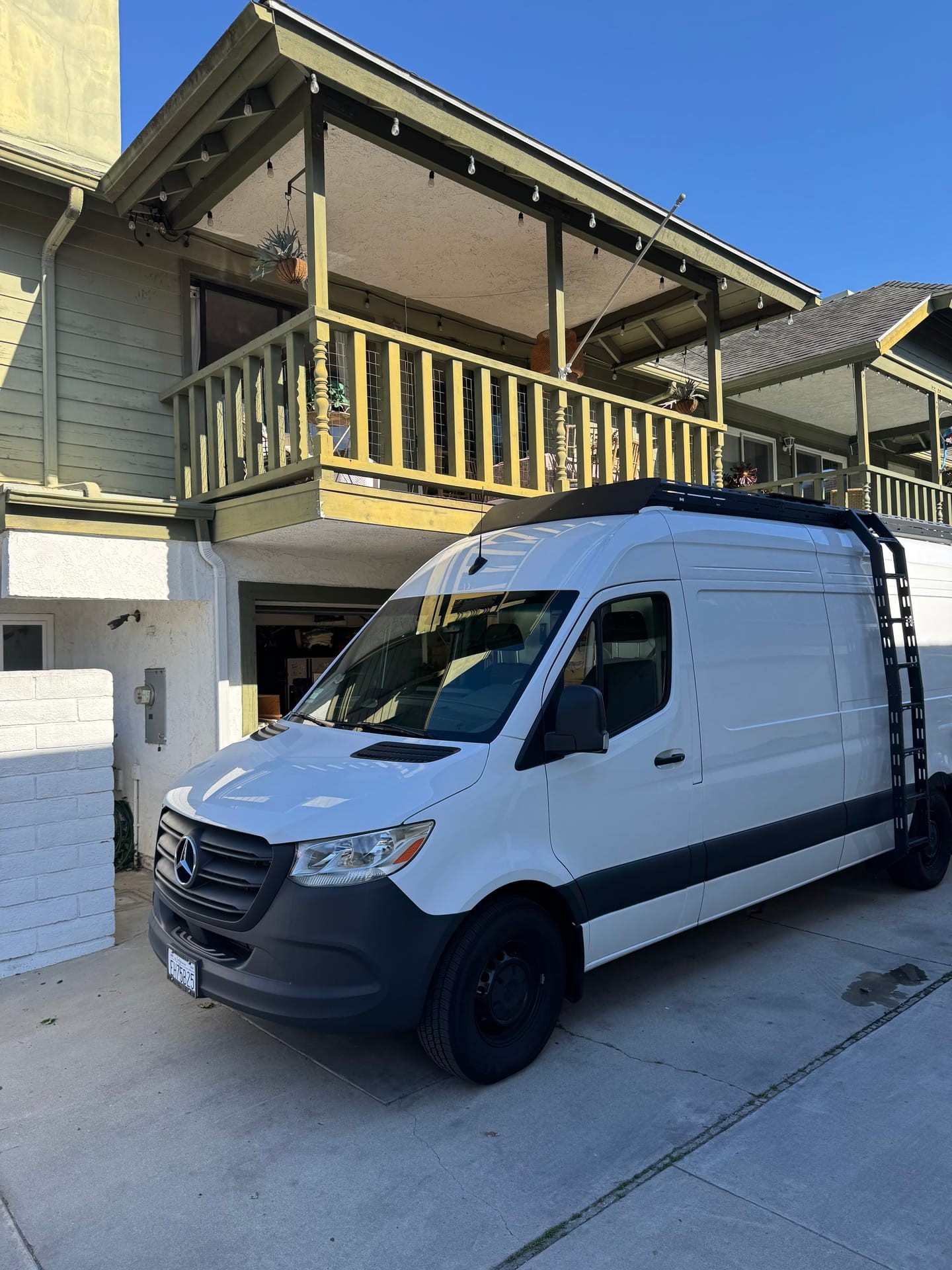
If you’re planning a Sprinter van conversion, the first thing you need to nail down is which van actually fits your life. Sprinter van dimensions vary significantly between configurations, and choosing the wrong wheelbase or roof height can limit your layout options before you even start building.
We build Sprinters regularly at our shop in Encinitas, CA, and the most common question we hear is some version of “how long is a Sprinter van?” or “will I be able to stand up inside?” This guide covers every measurement you need, broken down by wheelbase and roof height, with real-world context for how those numbers translate into a finished conversion.
Sprinter Van Configurations: What’s Available
Mercedes offers the Sprinter in several configurations. For van conversions, the cargo van variant is what you want. Here’s the lineup:
Wheelbases:
- 144-inch wheelbase (shorter)
- 170-inch wheelbase (standard long)
- 170-inch wheelbase extended (longest body)
Roof Heights:
- Standard Roof (too short for most conversions)
- High Roof (the most common choice for van builds)
- Super High Roof (available on the previous generation pre-2019 Sprinter only, not offered on the current 2019+ model)
The vast majority of Sprinter van conversions use the high roof option. It’s the sweet spot for standing height without making the van too tall for most parking garages. The standard roof doesn’t allow most adults to stand upright. The super high roof was discontinued after the pre-2019 generation, so most buyers shopping today won’t find one unless they’re looking at older models.
Sprinter Van Exterior Dimensions
Before we get to interior measurements, here are the exterior numbers. These matter for parking, garage clearance, and towing capacity planning.
| Measurement | 144” WB | 170” WB | 170” WB Extended |
|---|---|---|---|
| Overall Length | ~19 ft 5 in | ~22 ft 1 in | ~24 ft 1 in |
| Overall Width (mirrors folded) | ~7 ft 2 in (85.6 in) | ~7 ft 2 in (85.6 in) | ~7 ft 2 in (85.6 in) |
| Overall Width (mirrors out) | ~7 ft 8 in (92 in) | ~7 ft 8 in (92 in) | ~7 ft 8 in (92 in) |
| Overall Height (High Roof) | ~9 ft 1 in to ~9 ft 3 in | ~9 ft 1 in to ~9 ft 3 in | ~9 ft 1 in to ~9 ft 3 in |
| Overall Height (Standard Roof) | ~8 ft 4 in | ~8 ft 4 in | ~8 ft 4 in |
| Wheelbase | 144 in (12 ft) | 170 in (14 ft 2 in) | 170 in (14 ft 2 in) |
A few things to keep in mind with exterior dimensions:
- Parking garages typically have 7-foot or 8-foot clearances. A high roof Sprinter at over 9 feet will not fit in most standard garages. Plan accordingly.
- Overall width with mirrors out is about 7 ft 8 in. That’s manageable for most roads but tight in older urban areas and narrow campground spots.
- The 170 Extended adds about 2 feet of body length behind the rear axle compared to the standard 170. Same wheelbase, longer cargo area.
Sprinter Van Interior Dimensions (High Roof)
This is what really matters for a conversion. These are the raw, pre-build measurements for the high roof cargo van.
| Measurement | 144” WB | 170” WB | 170” WB Extended |
|---|---|---|---|
| Interior Length (cargo area) | ~11 ft 1 in (133 in) | ~14 ft 5 in (173 in) | ~15 ft 9 in (189 in) |
| Interior Height (floor to ceiling) | ~6 ft 7 in (79 in) | ~6 ft 7 in (79 in) | ~6 ft 7 in (79 in) |
| Interior Width (widest point, shoulder height) | ~70 in (~5 ft 10 in) | ~70 in (~5 ft 10 in) | ~70 in (~5 ft 10 in) |
| Width Between Wheel Wells (floor level) | ~51-53 in (~4 ft 3 in - 4 ft 5 in) | ~51-53 in (~4 ft 3 in - 4 ft 5 in) | ~51-53 in (~4 ft 3 in - 4 ft 5 in) |
| Rear Door Opening Width | ~61 in (~5 ft 1 in) | ~61 in (~5 ft 1 in) | ~61 in (~5 ft 1 in) |
| Rear Door Opening Height (High Roof) | ~73 in (~6 ft 1 in) | ~73 in (~6 ft 1 in) | ~73 in (~6 ft 1 in) |
| Rear Door Opening Height (Standard Roof) | ~61 in (~5 ft 1 in) | ~61 in (~5 ft 1 in) | ~61 in (~5 ft 1 in) |
Key Takeaways from These Numbers
Interior height of 6 ft 7 in is the number one reason the Sprinter high roof dominates the conversion market. Most adults can stand comfortably inside, which changes everything about how you use the space. Cooking, getting dressed, moving around, all of it becomes dramatically easier when you’re not hunched over.
The width narrows at the floor. The Sprinter’s body is about 70 inches wide at shoulder height, but the wheel wells intrude on both sides at floor level, reducing usable floor width to roughly 51-53 inches. This is the measurement that dictates your bed width and lower cabinet dimensions. A standard twin mattress is 38 inches wide, and a full mattress is 54 inches. With the wheel wells, you’re working in that range, which is why many builds use a custom-cut mattress or build platforms that extend over the wheel wells.
Cargo length is where the real decisions happen. The difference between about 11 feet (144 WB) and about 14.5 feet (170 WB) is the difference between a van with a bed, kitchen, and storage versus a van with all that plus a bathroom. That extra 3 feet changes the entire layout equation.
How Insulation Affects Your Usable Interior Space
Raw Sprinter van interior dimensions are not your finished interior dimensions. Once you insulate the walls, ceiling, and floor, you lose space on every surface.
Here’s what typical insulation does to your measurements:
| Surface | Insulation Method | Space Lost |
|---|---|---|
| Walls (each side) | Thinsulate AU6002 + wall panel | ~1.5 in per side (3 in total width loss) |
| Ceiling | Thinsulate AU6002 + ceiling panel | ~1 - 1.5 in |
| Floor | XPS rigid foam + plywood subfloor | ~1 in |
Post-insulation interior dimensions (approximate):
| Measurement | Raw | After Insulation & Finish |
|---|---|---|
| Standing Height | ~6 ft 7 in (79 in) | ~6 ft 4 in - 6 ft 5 in |
| Width at Shoulder | ~70 in | ~67 in |
| Width at Floor (between wells) | ~51-53 in | ~48-50 in |
That 2-3 inch height loss from ceiling insulation and floor buildup is why some builders try to cut corners on insulation thickness. We don’t recommend that approach. Proper insulation makes the van livable in hot and cold weather. Losing a couple inches of headroom is worth it.
For a deeper look at how we handle insulation and other systems, check out our services page.
Sprinter 144 vs 170: Which Wheelbase Should You Choose?
This is the biggest decision most people face when buying a base vehicle. Both wheelbases use the same cab, same engine options, and same width. The difference is entirely about how much living space you get behind the driver’s seat.
144-Inch Wheelbase: The Compact Option
Best for: Weekend warriors, couples without a bathroom requirement, people who want easier maneuverability, tighter budgets.
What fits in a 144 build:
- Fixed bed (queen width is tight but doable with platforms over the wheel wells)
- Galley kitchen with a 2-burner cooktop, sink, and compact fridge
- Electrical system with solar, batteries, and shore power
- Overhead storage cabinets
- Small dinette or convertible seating area
What’s hard to fit in a 144:
- A dedicated bathroom (possible but requires serious layout compromises)
- Large fridge/freezer combos
- Separate living and sleeping zones
The 144 drives more like a large SUV than a bus. It parks in standard parking spots, handles city driving well, and feels less intimidating for people new to driving larger vehicles. If you plan to use your van mostly for weekend trips and don’t need a bathroom, the 144 is a smart choice.
170-Inch Wheelbase: The Full-Timer’s Choice
Best for: Full-time van life, couples or small families, builds with a bathroom, anyone who wants a more spacious layout.
What fits in a 170 build:
- Everything in the 144 list, plus:
- Wet bath or dry bath with a shower and toilet
- Larger fridge (top-loading or full-size compressor fridge)
- Separate living area with a dedicated dinette or lounge
- More garage storage under a raised bed platform
- Washer/dryer combo (in premium builds)
The extra ~3 feet of interior length opens up layout options that simply don’t exist in a 144. A bathroom alone takes about 24-30 inches of length, and that’s before you account for a door or partition. In a 144, carving out bathroom space means shrinking the kitchen or losing your dinette. In a 170, you can have both.
We’ve built several 170 Sprinters, including our Anchor build and Crosswind build, both on the 170 Extended platform. Those builds include full bathrooms, complete kitchens, and dedicated sleeping areas without feeling cramped.
170-Inch Extended Wheelbase: Maximum Space
Best for: Full-time builds, families, anyone who wants a true home on wheels.
The 170 Extended adds about 16 more inches of cargo length compared to the standard 170. At nearly 16 feet of interior space, you have room for layouts that rival small apartments:
- Full wet bath with a real shower enclosure
- L-shaped or U-shaped kitchen with full counter space
- Fixed queen or king bed with under-bed garage storage
- Dedicated wardrobe or closet
- Workstation or office nook
The tradeoff is drivability. The 170 Extended is about 24 feet long overall. It handles highways and open roads fine, but tight city streets, U-turns, and parallel parking require more attention. It also limits campground options slightly, though most established sites can accommodate it.
Planning your budget? Check out our van build budget guide for a breakdown of what different build levels cost across all platforms.
Quick Comparison: 144 vs 170 vs 170 Extended
| Factor | 144” WB | 170” WB | 170” Extended |
|---|---|---|---|
| Interior Length | ~11 ft 1 in | ~14 ft 5 in | ~15 ft 9 in |
| Bathroom Feasible? | Barely | Yes | Yes, full-size |
| Drivability | Easy, SUV-like | Moderate | Requires experience |
| Parking | Standard spots | Most spots | Oversized spots |
| Typical Build Cost | $15K-$55K | $30K-$80K | $45K-$100K+ |
| Best For | Weekends, couples | Full-time, bathroom | Full-time, no compromises |
| Overall Length | ~19 ft 5 in | ~22 ft 1 in | ~24 ft 1 in |
Build costs listed are labor + materials. Vehicle not included.
Why Sprinter Van Dimensions Matter for Your Layout
Numbers on a spec sheet don’t mean much until you start planning where things go. Here’s how Sprinter dimensions translate into real conversion decisions.
Bed Placement and Size
The width between wheel wells (51-53 inches) is the critical number for beds. Most van beds are built in one of two ways:
-
East-west (sideways) at the rear: The bed runs the full width of the van. You can go up to about 70 inches wide (before insulation), which accommodates a standard queen. The tradeoff is that the bed blocks access to the rear doors unless you build a murphy-style setup or leave a gap.
-
Lengthwise along one wall: Common in 144 builds where you need the rear doors for gear access. Width is limited by the wheel wells unless you build a platform that extends over them.
Kitchen Layout
Kitchen counter space is dictated by the van’s width and the length you allocate. In a 170, you can build a galley kitchen 5-6 feet long with counter on one side and storage opposite. In a 144, expect a 3-4 foot kitchen run. The 70-inch interior width gives enough room for a 24-inch-deep counter with walkway space, but just barely.
For kitchen layout ideas, take a look at our camper van kitchen guide.
Bathroom Feasibility
This is the single biggest reason people choose a 170 over a 144. A functional wet bath needs roughly 24-30 inches of van length and the full width (or close to it). In a 144 with only about 11 feet of total interior length, dedicating 2.5 feet to a bathroom leaves just 8.5 feet for everything else, including your bed, kitchen, storage, and living space. It can be done, but it feels tight.
In a 170, the same bathroom takes up a smaller percentage of total space, and the remaining ~12 feet of usable length is enough for a full kitchen, fixed bed, and seating area.
Standing Height and Ceiling Storage
The 6 ft 7 in interior height (roughly 6 ft 4-5 in after insulation) is enough for most adults to stand comfortably. This also allows for overhead cabinets that are 8-12 inches deep without making the space feel claustrophobic. Some builders add a raised section or roof vent fan (like a MaxxAir) that cuts into ceiling space in one area. Plan those locations early.
How the Sprinter Compares to Other Vans
The Sprinter isn’t your only option. If you’re still deciding on a platform, here’s how it stacks up:
| Measurement | Sprinter (170 WB, High Roof) | ProMaster (159 WB, High Roof) | Transit (148 WB, High Roof) |
|---|---|---|---|
| Interior Height | ~6 ft 7 in (79 in) | ~6 ft 4 in (76 in) | ~6 ft 8 in (81 in) |
| Interior Width | ~70 in | ~75 in | ~68 in |
| Floor Width (between wells) | ~51-53 in | ~75 in (flat floor, no wheel wells; narrows to ~56 in at floor level behind rear axle) | ~54 in |
| Cargo Length | ~14 ft 5 in | ~12 ft 6 in | ~13 ft 6 in |
The ProMaster’s big advantage is its flat floor with no wheel well intrusion. The Transit offers the most standing height. The Sprinter offers the best combination of cargo length, build quality, and resale value. For a detailed breakdown, check out our Sprinter vs ProMaster comparison, Transit vs Sprinter comparison, and our Transit dimensions guide.
Ready to Plan Your Sprinter Build?
Getting the dimensions right is step one. Step two is turning those measurements into a layout that works for how you actually live, travel, and use your van.
At Emery Custom Builds, we work with Sprinters every week. We know where the measurement pinch points are, which layouts maximize your usable space, and how to build within the Sprinter’s dimensions without wasting an inch.
Whether you’re looking at a 144 for weekend adventures or a 170 Extended for full-time living, we can help you plan and build it. Check out our Sprinter van conversion services or browse our completed builds to see what’s possible.
Get in touch to start planning your Sprinter conversion:
- Call or text: (714) 257-5446
- Email: hello@emerycustombuilds.com
- Request a free consultation