Why Your Van's Smart Alternator Needs a DC-DC Charger
Newer Sprinter, Transit and ProMaster vans use smart alternators that vary voltage and can starve your house battery. Here's why a DC-DC charger fixes it.
If your van’s house battery charges fine sitting on shore power but never quite tops off on a long drive, the alternator is usually where the problem starts. Not because the alternator is bad. Because it isn’t doing what you’d expect it to do.
Most Sprinter, Transit, and ProMaster models built in the last several years use what’s called a smart alternator, sometimes called a variable-voltage alternator. It’s a fuel economy and emissions feature, and it changes how charging a house battery off the engine actually works.
What a smart alternator is actually doing
An older alternator puts out a steady voltage anytime the engine is running, roughly 13.8 to 14.4 volts, full stop. A smart alternator doesn’t. It’s controlled by the vehicle’s computer, and that computer decides how much the alternator works based on what the starter battery needs, how hard the engine is loaded, and what gets the best fuel economy in that moment. Sometimes that means full voltage. Sometimes it means the alternator backs off to almost nothing, even while you’re driving down the highway.
That’s not a defect. It’s the vehicle doing exactly what it was designed to do. The problem only shows up once you try to run a second, larger battery bank off that same alternator and expect it to charge the way an old fixed-voltage system would.
Why that breaks a simple battery isolator
The older way to charge a house battery off the alternator was a basic isolator or a voltage-sensing relay: when the starter battery hits a certain voltage, it connects the house battery to the same circuit. That works fine when the alternator is holding a steady voltage. It falls apart against a smart alternator, because the voltage the isolator is watching for might only show up for a few minutes at a time, or not at all on a short trip.
The result is a house battery that seems to charge sometimes and not others, with no obvious pattern from the driver’s seat. That inconsistency is usually smart-alternator behavior, not a wiring fault.
What a DC-DC charger does differently
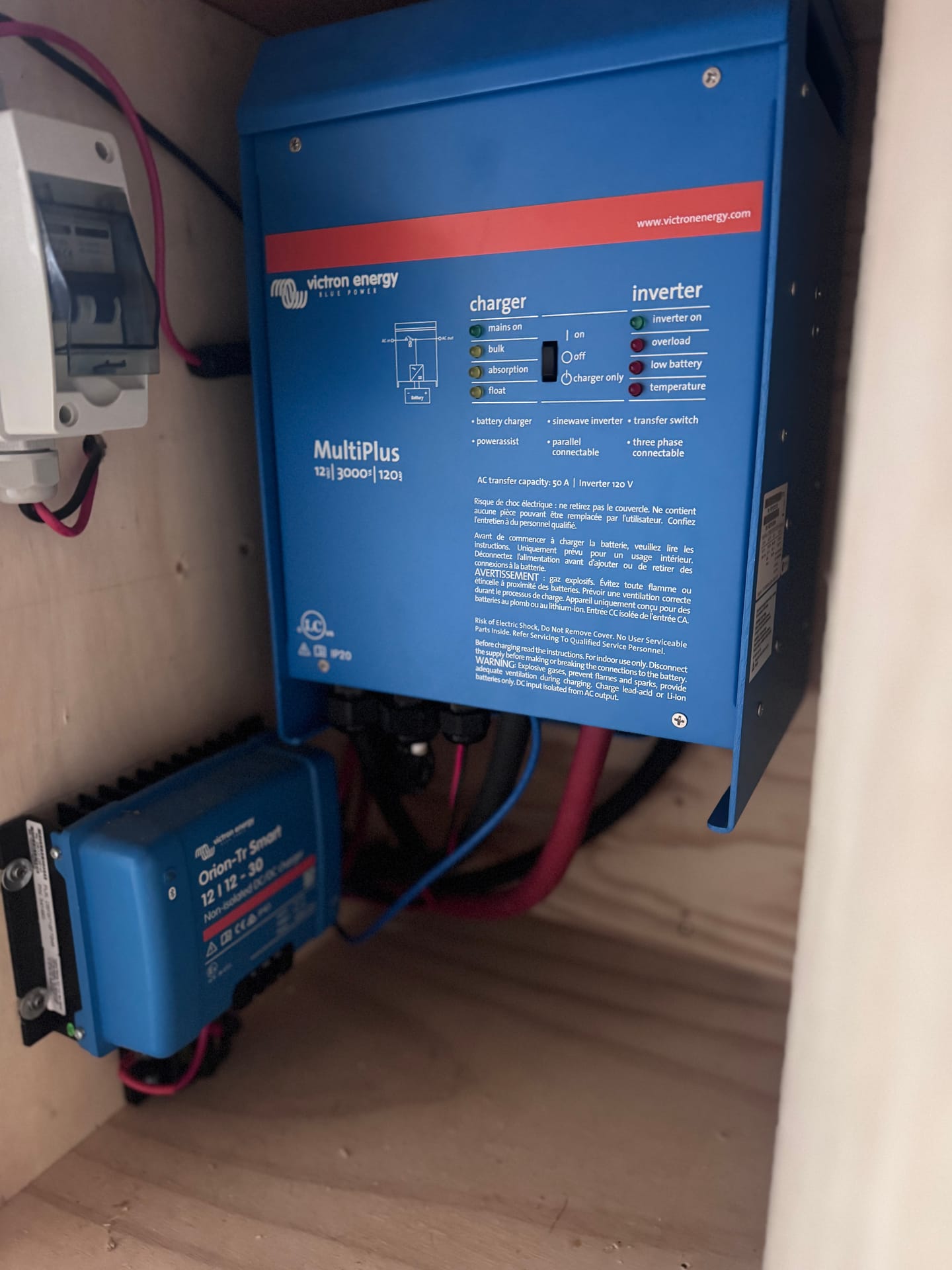
A DC-DC charger doesn’t wait for a specific voltage to show up. It’s a buck-boost converter: it takes whatever voltage the alternator happens to be putting out at that moment, low or high, and converts it into the correct charge profile for the house battery. The house battery sees a consistent, properly staged charge regardless of what the alternator is doing on the other side of the converter.
This is why we build our systems around a Victron Orion DC-DC charger pulling power from the alternator while you drive, paired with Victron MPPT solar charging and a Victron 3000W inverter/charger. It’s not a workaround bolted on after the fact. It’s the part of the system designed specifically to handle a smart alternator correctly, which is what every current Sprinter, Transit, and ProMaster chassis has under the hood.
Why this matters more on newer vans
This isn’t a niche issue anymore. Smart alternators are the standard, not the exception, across current Sprinter, Transit, and ProMaster chassis, which means any build going into a newer van needs to plan for it from the start rather than discover it after the walls are closed up. It also affects what a build costs to do right. A proper DC-DC charger, sized to the battery bank, is a line item worth understanding rather than a detail to skip past, and it’s one reason platform costs vary the way they do on a Transit conversion.
Get the charging side of the system right and the rest of it takes care of itself: the battery bank fills back up on the drive, not just when you’re plugged in, and it’s actually ready to go when you pull up somewhere for a weekend trip instead of running low before you’ve even parked.
The bottom line
A smart alternator isn’t a problem to work around, it’s a normal part of how current vans are built, and the fix is straightforward once you know what’s actually happening. A DC-DC charger sized correctly to your battery bank handles it without you having to think about it again.
If you’re planning a build and want the charging side done right from the start, or you already have a van and the house battery isn’t charging the way it should on the road, contact us and we’ll walk through what your alternator is actually doing.