Why Quality Parts Matter in a Custom Van Conversion
Two van build quotes can look identical and land $20,000 apart. Here is what we spec inside the walls, and why cheap parts cost more later.
If you have started pricing out a custom van build, you have probably noticed the range is enormous. Two shops can quote what looks like the same list of features and land $20,000 apart. A lot of that gap comes down to one thing most people do not think to ask about: what is actually inside the walls.
I get some version of this question on almost every consult. Why does a name brand inverter cost three times what a similar looking one costs online? Why does the wire gauge running to your fridge matter if you cannot see it? Why is one shop’s electrical line item double another’s?
The honest answer is that in a lot of cases it does not matter, until it does.
What “Looks the Same” Actually Means
Van systems live in a rough environment. They vibrate down washboard roads for years, they bake inside a metal box in the desert, and they get bumped, jostled, and occasionally soaked. A component rated for that environment and a component that just looks like it can be nearly indistinguishable sitting on a shelf.
The difference shows up in the failure mode, and it usually shows up late.
A cheap DC-DC charger might work fine for eight months and then quietly stop keeping your house battery topped off on cloudy days. You will not find out in the shop. You will find out when the battery is dead in a trailhead parking lot. A quality one is built with the thermal protection and tolerances that account for exactly the abuse a van throws at it.
Wire is the same story. Undersized or untinned wire behaves fine on a bench and then corrodes at the crimp after two winters near the coast. The build looked identical the day it rolled out. The difference showed up two years and 40,000 miles later.
Where It Actually Matters Most
Not every part in a van needs to be top of the line. A cabinet pull can be whatever fits the design. But there are systems where the cost of failure is high enough that cutting corners is not a discount, it is a bet.
Electrical. Wire gauge, fusing, and connectors are not the place to save money. A dead battery 200 miles from the nearest outlet is an inconvenience. An undersized or unfused circuit is a fire risk in a vehicle you sleep in. This is also the system that is hardest to fix after the fact, because most of it disappears behind finished panels.
Plumbing fittings. A slow leak inside a wall you cannot see costs far more to fix later than it would have cost to prevent. Fittings and connections are a small fraction of a plumbing budget and the source of most plumbing failures.
Structural hardware. Anything holding a cabinet, a bed platform, or a swivel seat needs to handle real loads on a moving vehicle, not just look sturdy sitting still. A van is a 6,000 pound vehicle that occasionally stops fast.
Charging and solar components. These get the least attention during a build and the most attention when they fail, usually somewhere remote.
Insulation. Less obvious, but the same logic. We use 3M Thinsulate AU6002 on walls and ceilings and XPS rigid foam on the floor because Thinsulate manages moisture without needing a vapor barrier. Cheaper batting traps water against bare metal, and you find out when something starts smelling in year two. More on that in why we use Thinsulate.
What We Actually Spec, and Why
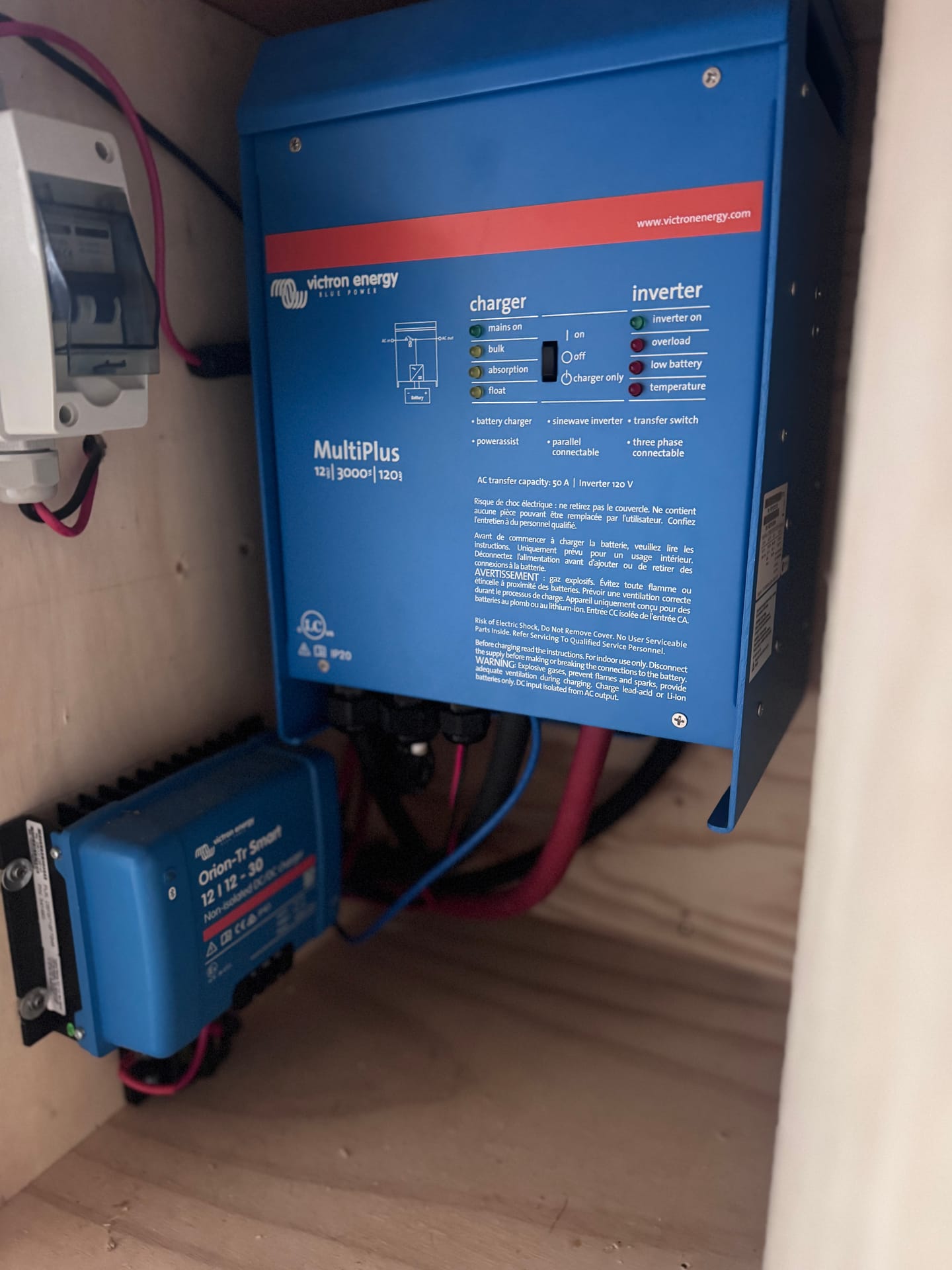
We standardized on a core electrical system instead of re-picking components on every build. The stack is Victron for power conversion and charging: a 3000W inverter/charger, MPPT solar charging, and Orion DC-DC alternator charging, paired with a Renogy lithium bank sized to how the client actually uses the van. You can see it in the Haven Transit and Anchor Sprinter builds.
Standardizing is part of the quality argument, not separate from it. When the same system goes into build after build, I know how it behaves, I know how to size it, and I know how to talk a client through a problem over the phone two years later. A shop that picks a different inverter every time based on price is learning a new system on your van.
If you want the longer version of that reasoning, we wrote it up in why we build on Victron.
Where You Can Flex
Cost control is real, and not every dollar belongs in the same place. On most builds the flexible budget lives in finishes and convenience: countertop material, cabinet fronts and hardware, upholstery, lighting fixtures, exterior accessories, and how much storage gets custom fabricated versus kept simple. None of that is hiding behind a wall, and none of it strands you.
Battery capacity and solar are also legitimately scalable. A 200Ah bank with no solar is a real system for someone who plugs in most weekends, and it costs a lot less than 600Ah with a full array. That is sizing, not corner cutting, and it is a conversation worth having early because it affects the whole design.
The line I hold is components inside a system we build and warranty. We cover our workmanship for a year and pass through the manufacturer warranty on parts, and that only works when I know exactly what is in there.
The Real Cost Comparison
When you compare two quotes, it is tempting to treat every line as equivalent and look at the bottom number. But a $150 part and a $40 part that do the same job on paper are not doing the same job. One is designed to survive a van’s actual life. The other is designed to survive a spec sheet.
This is also why a quote from a shop that has been doing this a while sometimes looks higher than one from someone newer. It is usually not padding. It is components chosen by someone who has already seen what happens when you pick the other one. If you want the full picture of where the money goes on a build, our van conversion cost guide breaks it down system by system.
What to Ask When You Are Comparing Quotes
Four questions will tell you most of what you need to know:
- What specific brand and model of inverter, charge controller, and DC-DC charger is included?
- What wire gauge and fusing is the system built to, and who sized it?
- What is covered under warranty, for how long, and who handles a failure two years out?
- Which line items would you cut first if I needed to reduce the budget, and why those?
A shop that answers all four specifically, with reasons tied to how you plan to use the van, is telling you something real about how they build. A shop that answers in generalities is telling you something too.
If you are working through this on your own build, that is exactly the conversation we have on every quote call. We go system by system, based on how you actually plan to travel, and we are direct about where the money matters and where it does not. Reach out through our contact page and let’s talk through yours.