
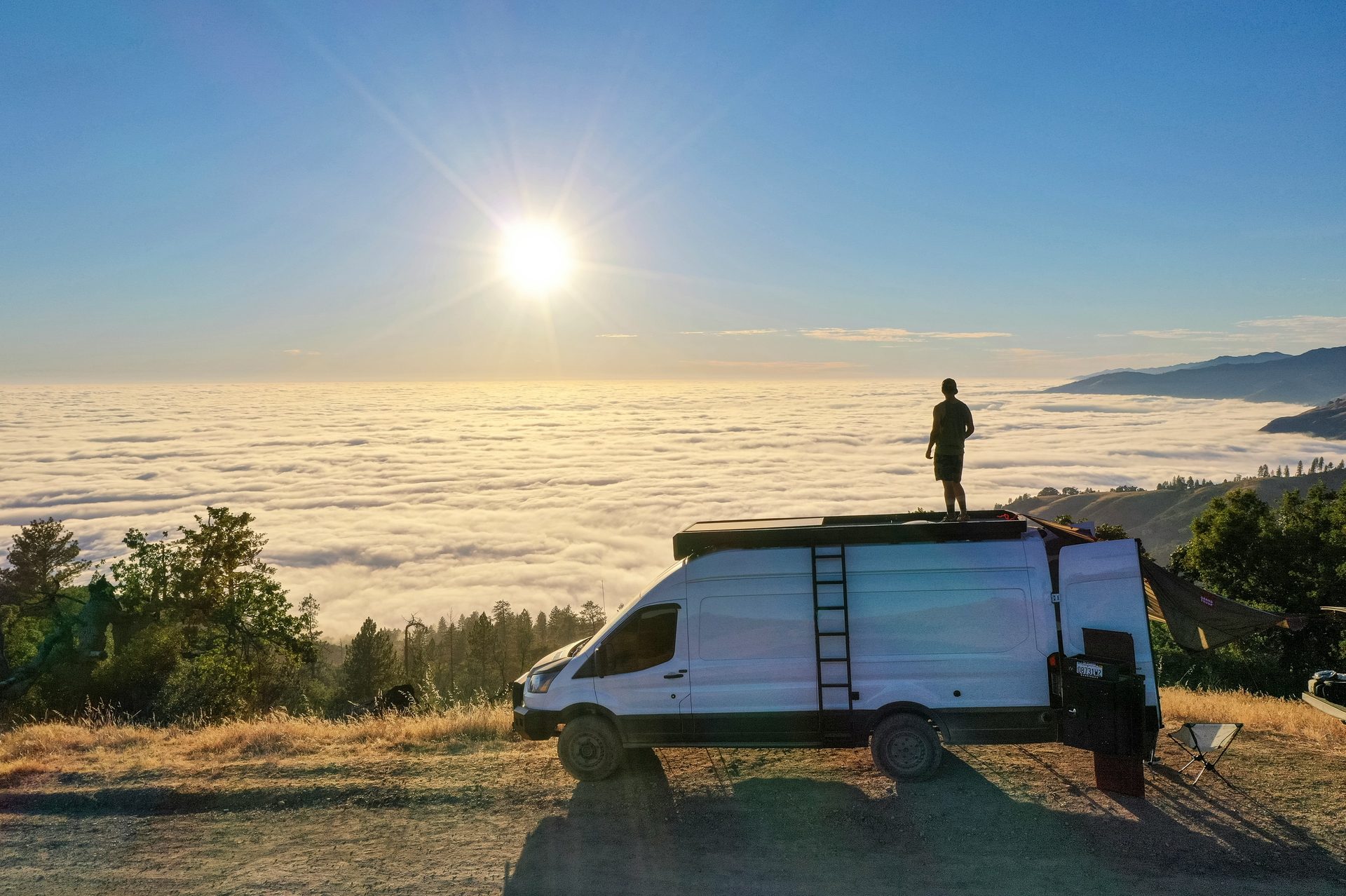
What Actually Makes a Camper Van Trail-Ready
Buying a 4x4 camper van is one thing. Building one that can actually handle backcountry roads, remote BLM land, and rough forest service trails is something else entirely. A lot of people assume that slapping a “4x4” badge on a van makes it off-road capable. It doesn’t. Four-wheel drive is the starting point, not the finish line.
We build custom Sprinter van conversions and Transit conversions here in Encinitas, CA, and we see the full spectrum of what people want from an off-road camper van. Some want to reach a slightly rougher campsite. Others want a full expedition van that can handle washboard desert roads for hundreds of miles. The builds are very different.
This guide covers the best platforms for a 4x4 camper van, what upgrades actually matter for off-road capability, realistic costs, and an honest look at what a converted van can and cannot do on the trail.
If you’re looking for a breakdown of 4x4 vs AWD drivetrains and which van platforms offer what, check out our complete guide to 4x4 and AWD vans. This post focuses on the off-road build itself: the vehicles, the upgrades, and what it takes to make a camper van truly trail-ready.
What Makes a Camper Van Truly Off-Road Capable
Having 4WD or AWD gets power to all four wheels. That matters. But a stock 4x4 van sitting on highway tires with 6 inches of ground clearance is going to have a bad time on anything rougher than a gravel road. Real off-road capability comes from a combination of upgrades that work together.
Suspension Lift (2-4 Inches)
A suspension lift raises the body, the frame and the running boards, and it opens up the wheel wells for larger tires. What it does not do is raise the rear differential, which is bolted to a live axle located by the tires and stays exactly where it was. Since the differential is usually the first thing to touch on a rough road, tires are what actually buy you clearance and the lift is what makes room for them. We wrote up the full picture, with prices, in our guide to van suspension upgrades.
For Sprinters, companies like Agile Off Road, Van Compass, and RB Components make lift kits ranging from 2” to 4”. Most overland builds land in the 2-3” range, which gives meaningful clearance improvement without making the van feel top-heavy or difficult to park in normal situations.
A word of caution: going above 3 inches on a van changes the driving dynamics noticeably. These are tall, heavy vehicles with a high center of gravity. More lift means more body roll in corners and more wind sensitivity on the highway. Find the right balance for how you actually drive.
All-Terrain Tires
Tires are where the rubber literally meets the trail. Stock van tires are designed for highway fuel economy and ride comfort. They have minimal tread depth and zero grip on mud, sand, or loose rock.
The most popular all-terrain tire choices for off-road camper vans:
- BFGoodrich KO2 in 245/75R16 or 265/75R16 (the gold standard for overland vans)
- Falken Wildpeak AT3W (excellent wet and snow performance, slightly quieter than KO2s)
- Toyo Open Country AT3 (durable, good value)
- General Grabber ATx (budget-friendly, still capable)
Expect to spend $800 to $1,500 for a set of four, depending on size. Larger tires (which you can fit after a lift) provide even more ground clearance and better obstacle handling. Just make sure your speedometer is recalibrated and your fender clearance is checked after upsizing.
Skid Plates and Underbody Protection
The underside of a van is exposed. Oil pans, transmission cases, fuel tanks, and exhaust components are all vulnerable on rough terrain. Skid plates are aluminum or steel armor that bolt underneath to protect these critical components.
For a Sprinter, a full skid plate setup (engine, transmission, and transfer case protection) runs $800 to $2,000+ depending on the manufacturer and material. Van Compass, Agile Off Road, and Owl Vans all make Sprinter skid plates. For Transits, the aftermarket options are growing but not as extensive.
If you plan to drive on rocky trails or roads with large ruts, skid plates are not optional. One bad hit to an oil pan 50 miles from pavement can end your trip and your engine.
Recovery Points and Gear
Getting stuck is part of off-roading. The difference between a minor inconvenience and a disaster is whether you have the gear to get unstuck.
Every off-road camper van should carry:
- Front and rear recovery points rated for the vehicle’s weight (factory tow hooks are not always rated for recovery pulls)
- A kinetic recovery rope (not a tow strap with hooks, which can snap and cause injury)
- A set of traction boards (Maxtrax or similar) for sand, mud, and snow
- A basic tool kit and tire repair kit
- An air compressor for re-inflating tires after airing down on trails
Optional but valuable: a high-lift jack, a winch (adds significant weight and cost), and a satellite communicator like a Garmin inReach for areas without cell service.
Off-Grid Systems
An off-road camper van needs to be self-sufficient. The whole point of going off the beaten path is to camp where there are no hookups, no services, and no cell towers. That means your van needs to generate its own power, carry its own water, and manage waste independently.
For a capable off-grid setup, you’re looking at:
- Solar panels: 400-800W on the roof, enough to keep batteries topped off even in partial shade
- Lithium batteries: 200-400Ah of lithium iron phosphate (LiFePO4) for reliable power storage
- Water storage: 30-50+ gallons of fresh water, ideally with a filtration system
- Diesel or propane heater: for cold-weather camping without running the engine
We cover off-grid electrical systems in detail in our electrical system guide. The electrical system is one of the biggest cost drivers in any conversion, and off-road builds tend to need more capacity because you’re spending more time away from shore power. Check our van build budget guide for a full cost breakdown by system.
Best Platforms for Off-Road Camper Van Builds
Not every van is a good candidate for an off-road build. The platform you start with determines what’s possible, how much it costs, and how well it performs on the trail.
Mercedes Sprinter 4x4
The Sprinter 4x4 is the most popular platform for off-road camper van conversions, and for good reason. It’s the only major van with a factory AWD system. On 2015-2022 models, this included a low-range transfer case option (though with a mild 1.42:1 ratio compared to dedicated off-road vehicles). The 2023+ system is full-time AWD without low-range, though still very capable on moderate terrain. Even without true 4WD, the Sprinter AWD is well above a typical crossover in off-road capability, especially once you add suspension and tire upgrades.
Why builders and owners love it:
- Factory AWD means the warranty covers the drivetrain
- Massive aftermarket support for lifts, tires, armor, and accessories
- Available in 144” and 170” wheelbases with high roof options
- The diesel engine (3.0L V6 on 2019-2022 models, 2.0L I4 turbo on 2023+) is torquey and fuel-efficient
- Proven track record with thousands of overland Sprinters on the road
The downsides:
- Expensive. A used Sprinter 4x4 in decent shape starts around $50K-$70K+ for newer models
- The 4x4 models are harder to find, especially in the 170” extended configuration
- Parts and service are Mercedes-priced
If you’re serious about building an off-road camper van and budget allows, the Sprinter 4x4 is the platform to beat. We build on Sprinters more than any other platform. See our Sprinter van conversion page for examples of what we’ve done.
Ford Transit with Quigley 4x4
The Ford Transit doesn’t come with factory 4WD. It’s rear-wheel drive only. But Quigley Motor Company has been converting Ford vehicles to 4x4 for decades, and their Transit conversion is the go-to aftermarket solution.
Quigley installs a full 4x4 system: transfer case, front driveshaft, front differential, and modified front suspension. It’s a professional conversion, not a bolt-on kit. The result is true 4WD with low-range capability.
Why the Transit + Quigley works:
- Ford parts are cheaper and more widely available than Mercedes
- The Transit platform is physically tough and well-suited to hard use
- Lower entry price than a Sprinter 4x4 (Transit + Quigley conversion still comes in under a comparable Sprinter 4x4)
- Available in multiple wheelbases and roof heights
The downsides:
- The Quigley conversion adds $15,145-$16,145 to the vehicle cost on pre-2020 Transits (2020+ is not currently orderable)
- Not factory-backed, so the 4x4 system has its own warranty separate from Ford’s
- Fewer aftermarket off-road accessories compared to the Sprinter (though this is improving)
The Transit is a great choice if you want 4x4 capability but prefer working within the Ford ecosystem. Learn more on our Transit van conversion page.
Sportsmobile
Sportsmobile has been building 4x4 adventure vans since the 1960s. They’re a name synonymous with overland van travel in the U.S. Historically, they converted Ford E-Series vans and Sprinters into fully equipped expedition vehicles, often with pop-top roofs and serious off-road modifications.
The reality in 2026: Sportsmobile’s production has slowed significantly. Finding a new Sportsmobile is difficult, and the used market commands premium prices because of the brand’s reputation. A used Sportsmobile 4x4 in good condition can easily sell for $80K-$150K+ depending on age, platform, and build level.
If you find one in good shape, they’re excellent. The engineering is solid and proven over decades. But for most people shopping today, you’re looking at buying used or going with a different builder on a modern platform.
Storyteller Overland
Storyteller Overland builds adventure-focused camper vans on the Sprinter 4x4 and Transit AWD platforms. Their MODE series has a strong following in the overland community.
What they do well: Storyteller builds purpose-designed adventure vans with features like a fold-down gear garage, dedicated bike/gear storage, and a layout optimized for active travelers rather than full-timers. Their vans come with suspension upgrades and off-road tires from the factory.
Worth knowing: Storyteller vans are production builds, not custom. You get their layout and their spec. If that matches what you want, great. If you need a custom floor plan, custom electrical system, or specific features they don’t offer, a custom build from a shop like ours gives you exactly what you need instead of compromising on a production layout.
Winnebago Revel
The Winnebago Revel is one of the most recognizable off-the-lot 4x4 camper vans on the market. Built on the Sprinter 4x4 platform, it rides on the stock Sprinter 4x4 suspension (with an optional Agile Offroad suspension upgrade available from Winnebago), comes with all-terrain tires, and has a surprisingly capable off-grid electrical system including lithium batteries and 210-220W of solar.
Why it’s popular: You can buy one from a dealer, drive it off the lot, and immediately head to the backcountry. No waiting for a custom build. No sourcing a 4x4 van separately. It’s an all-in-one solution that works well enough for weekend warriors and occasional overlanders.
The trade-offs: The Revel’s interior is compact and optimized around a specific use case (the power-lift bed and gear garage take up significant space). Fit and finish is production-grade, not custom-grade. And MSRP runs around $257K-$278K new (2025-2026 pricing), which is a lot when you consider that a custom-built Sprinter 4x4 camper van with a layout designed exactly for your needs can come in at a similar price point or less.
Ready to Build Your Off-Road Van?
If you’re planning a 4x4 camper van build and want it done right, we can help. We build custom off-road-capable van conversions on Sprinter and Transit platforms with the suspension, electrical, and interior systems matched to how you actually plan to use the van.
Call us at (714) 257-5446 or email hello@emerycustombuilds.com to start the conversation. Or fill out our contact form and tell us about your project.
DIY vs Professional Off-Road Van Builds
The DIY van build community is huge, and plenty of people have built impressive off-road rigs in their driveways. But an off-road build adds layers of complexity that a standard conversion doesn’t have.
Where DIY makes sense:
- Basic interior buildout (bed platform, simple cabinetry, basic electrical)
- Installing traction boards, recovery gear, and accessories
- Adding a roof rack or ladder
Where professional work pays for itself:
- Suspension lifts require proper alignment, brake line extensions, and shock tuning. A bad lift install can cause premature tire wear, poor handling, and unsafe driving dynamics.
- Electrical systems for off-grid use need proper wire sizing, fuse protection, battery management, and shore power integration. A fire in the backcountry is not a situation you want to be in.
- Skid plate and armor installation needs to account for heat dissipation, access for maintenance, and proper mounting that won’t vibrate loose on rough roads.
- Plumbing and water systems that won’t freeze, leak, or contaminate your water supply when you’re bouncing down a washboard road at altitude.
The stakes are higher on an off-road van because you’re farther from help when something goes wrong. A loose electrical connection or a plumbing leak is annoying in a campground with cell service. It’s a real problem 40 miles down a dirt road in the desert.
Realistic Costs for an Off-Road Camper Van
Let’s talk numbers, because this is where a lot of people get surprised.
The vehicle: A used Sprinter 4x4 (2019-2023) in good condition runs $50K-$70K+. A new one with the 4x4 option can push $65K-$80K+ before any conversion work. A Transit with a Quigley conversion starts lower, around $45K-$60K for vehicle plus 4x4 conversion.
The conversion build:
- Simple build (insulation, simple bed/storage, basic electrical, no plumbing): $15K-$30K
- Mid-range build (full cabinetry, kitchen, electrical with solar, basic plumbing): $35K-$55K
- Higher-end build (custom everything, full off-grid electrical, full plumbing, climate control): $60K-$100K+
All prices are labor + materials, vehicle not included.
Off-road-specific upgrades (on top of the conversion):
- Suspension lift kit + installation: $2K-$5K
- All-terrain tires: $800-$1,500
- Skid plates: $800-$2,000
- Recovery gear: $500-$1,500
- Rear tire carrier + ladder: $1,500-$3,500
- Roof rack: $1,000-$3,000
Total realistic range: For a complete, well-built off-road camper van, you’re looking at $80K on the low end (older vehicle, simpler conversion, minimal off-road upgrades) to $150K+ on the high end (newer Sprinter 4x4, higher-end conversion, full armor and accessories). Some high-end expedition builds push well past $200K.
These are real numbers based on what we see in our shop and in the market. Anyone telling you that you can build a fully capable off-road camper van for $30K is either leaving out the cost of the vehicle or cutting serious corners on the build. For detailed pricing breakdowns, check our van conversion cost guide.
Where to Take Your 4x4 Camper Van
Having the van is half the equation. Knowing where to go is the other half.
BLM Land
Bureau of Land Management land is the backbone of free dispersed camping in the western U.S. Millions of acres are open to camping for up to 14 days in most areas, with no reservations and no fees. Many BLM access roads are well-maintained gravel. Some are not. A 4x4 camper van opens up the rougher access points that 2WD vehicles can’t reach.
Popular BLM areas for overland van camping: Alabama Hills (CA), Anza-Borrego (CA), Moab area (UT), Sedona (AZ), and the entire desert Southwest corridor.
National Forest Dispersed Camping
Most national forests allow dispersed camping (camping outside of designated campgrounds) for free. Forest service roads range from smooth gravel to rocky, rutted, seasonal-access-only tracks. A properly equipped 4x4 camper van handles the vast majority of forest roads without issue.
Overland Trail Routes
Longer overland routes like the Trans-America Trail, Mojave Road, and various segments of the Continental Divide are increasingly popular with van-based overlanders. These routes are generally passable for a well-built 4x4 van, though some sections may require detours designed for smaller vehicles.
Research your route ahead of time. Know the width restrictions, water crossings, and elevation changes. A Sprinter is about 7 feet wide and over 9 feet tall. Some trails that are fine for a Tacoma simply won’t fit a full-size van.
Know Your Limits: An Honest Take
We need to be straight about this: a lifted Sprinter 4x4 with all-terrain tires is not a Jeep Wrangler. It’s not a Toyota Land Cruiser. It’s a tall, heavy vehicle with a high center of gravity that happens to have four-wheel drive and some extra ground clearance.
What a 4x4 camper van handles well:
- Gravel and dirt forest roads
- Sandy desert access roads (air down your tires)
- Moderate rocky trails with good line selection
- Snow-covered roads with proper tires
- Steep grades (this is where low range shines)
What it does not handle well:
- Tight, technical rock crawling trails
- Deep water crossings (electrical systems and air intakes are low)
- Narrow single-track trails designed for ATVs or side-by-sides
- Extreme off-camber situations (the height and weight work against you)
The best off-road van drivers know when to turn around. Breaking a van 100 miles from the nearest paved road because you pushed past what the vehicle can do is expensive, dangerous, and completely avoidable.
Build the van for the 95% of terrain you’ll actually drive. Don’t overbuild for the 5% that’s better suited to a dedicated off-road vehicle.
Start Your Off-Road Build With Emery Custom Builds
We build 4x4 camper vans and off-road-capable van conversions for people who want to go further than the campground. Whether you’re starting with a Sprinter 4x4 you already own or you’re still figuring out the right platform, we’ll help you plan a build that matches your travel style and your budget.
When you’re ready to talk about your build, reach out.
Call (714) 257-5446 | Email hello@emerycustombuilds.com | Get in touch