Dead Starter Battery in a Van: What Your House Bank Can Do
Your van's house battery and starter battery are separated on purpose. A new Victron Orion XS feature lets one help the other when the engine won't crank.
Here is a situation almost every van owner eventually runs into. You have been parked at a trailhead for three days. The fridge, the fan and the lights have all been running, and your house battery bank is still sitting at 70 percent because the solar kept up. You turn the key and the engine clicks at you.
All that stored power, and none of it can start your van.
That is not a fault. It is the system doing what it was designed to do, and it is worth understanding before you shop for a fix.
Why the two batteries are kept apart
Every properly built van has two separate electrical worlds. The starter battery is the vehicle’s own, and its one job is turning the engine over. The house bank is the one we install for the conversion, and it runs the fridge, lights, fan, water pump and inverter.
They are deliberately isolated from each other. If they were simply wired together, a long weekend of running a fridge would flatten the starter battery along with everything else, and you would be stranded every time you camped without driving. Keeping them separate means the worst a heavy night of house loads can do is leave you with a dim van, not a dead one.
The bridge between them is a DC-DC charger. While the engine runs, it takes power from the alternator and charges the house bank at the right profile for lithium. That is a one-way street by design. Power flows alternator to house, never house to starter. Which is why a full house bank has never been any help to a starter battery that went flat sitting still.
What Victron just changed
Victron has added a feature called Emergency Reverse Charging to the Orion XS DC-DC charger range, delivered in firmware v1.15. It lets the charger temporarily run the other way.
You open the VictronConnect app, tap the engine starter charge icon on the status screen, and the Orion XS reverses direction: power moves from your house battery bank back into the vehicle’s starter battery. It runs for 15 minutes, then stops for a 5 minute settling period, and during that pause you try starting the engine.
The limits are sensible and worth knowing before you count on it:
- The starter battery is charged to a maximum of 14.4V. On an Orion XS 1400 feeding a 24V starter battery, that maximum is 28.8V.
- Reverse charging current is capped at whichever is lower, your configured current limit or half the unit’s rated current.
- The charger reduces reverse current automatically if the house battery voltage sags too far, so it will not drain your house bank trying to save the starter.
- It is available once forward charging has stopped, which happens when input voltage lockout is active or the unit detects the engine has shut down. It also works when the charger is in its remote-off state.
It covers the full Orion XS lineup: the 12/12-50A, the 12/12-70A, and the multi-voltage 1400, which now also has a setting for whether the starter battery is 12V or 24V. Victron has said this is the first of several reverse-charging features planned for the range.
What it does not do
It gets your engine turning. It does not tell you why the starter battery went flat, and that part matters more than the rescue does.
A starter battery that dies while parked is usually telling you one of three things. It may be old, since a lead-acid starter battery five or six years in will not hold much overnight in the cold. It may be carrying a parasitic draw, meaning something is still pulling from the vehicle side when everything is supposedly off. Or the van may not be driven enough between trips for the alternator to keep it topped up.
The second one is the one to take seriously, because it is the one a conversion can cause. Anything wired to the vehicle side rather than the house side, an accessory, a radio, an aftermarket alarm, a poorly chosen relay, will keep sipping current forever. When we wire a build, house loads live on the house bank and the vehicle side is left to do its own job. If you are chasing a starter battery that keeps going flat, that is the first question to ask about your own van.
How we think about it in a build
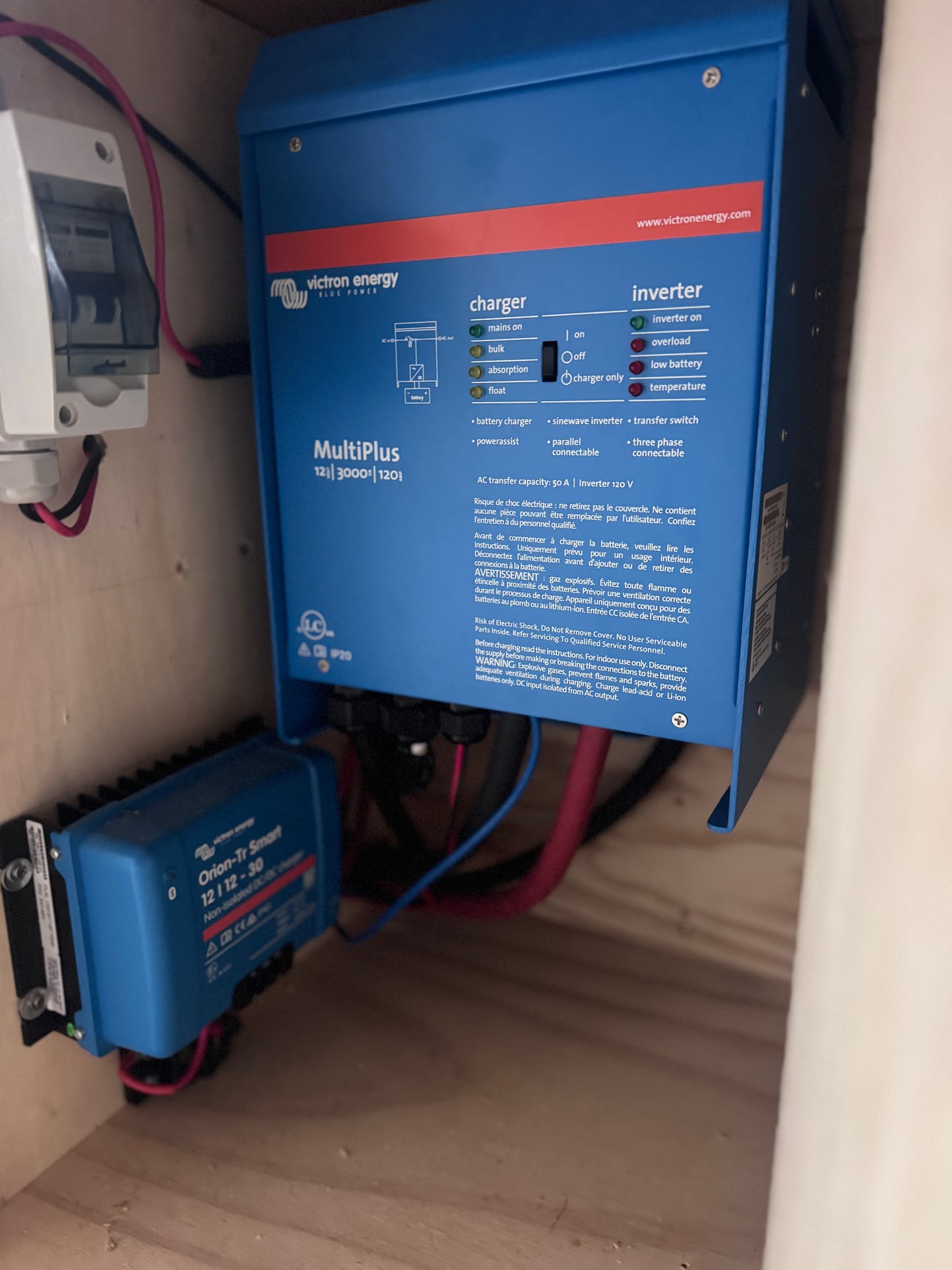
We build our electrical systems around Victron equipment for reasons that have nothing to do with any single feature: a Victron 3000W inverter/charger, Victron MPPT solar charging, and Victron Orion DC-DC alternator charging, paired with a Renogy lithium bank sized to how the customer actually uses the van. Trip length, what they run, how much driving and how much sun they get. Common banks run somewhere between 200Ah and 600Ah, and the number comes out of that conversation rather than a catalog page.
Emergency Reverse Charging is a good illustration of why we standardize on one ecosystem. Nobody bought an Orion XS for this feature, because it did not exist. It arrived in a firmware update, and every van already running that hardware got it for free. That is the quiet argument for picking components from a manufacturer that keeps developing them, and for keeping your firmware current instead of leaving it at whatever shipped in the box.
If you want the longer version of why a DC-DC charger is mandatory on a modern van in the first place, we wrote that up separately in why your van’s smart alternator needs a DC-DC charger. The short answer is that current Sprinter, Transit and ProMaster chassis all use variable-voltage alternators, and a basic isolator cannot charge a house bank properly off one. The full reasoning behind the component choices is in why we spec Victron, and how we arrive at a bank size is in battery sizing.
The practical takeaway
If your van has a Victron Orion XS, update the firmware this week. It is a free capability that you will be glad to have at a trailhead with no cell service, and knowing it exists before you need it is most of the value.
If you are planning a build and this is the first time you have thought about the two banks being separate, that is worth a conversation before anything gets wired. Whether the rescue path is an Orion XS or a jump pack in the door pocket, it should be a decision somebody made on purpose rather than something you discover 40 miles from pavement.
We build custom conversions on Sprinter, Transit and ProMaster platforms out of Encinitas, CA, and the electrical system is where we spend the most design time on every one of them. If you want yours thought through properly, get in touch and tell us how you actually plan to use the van.